
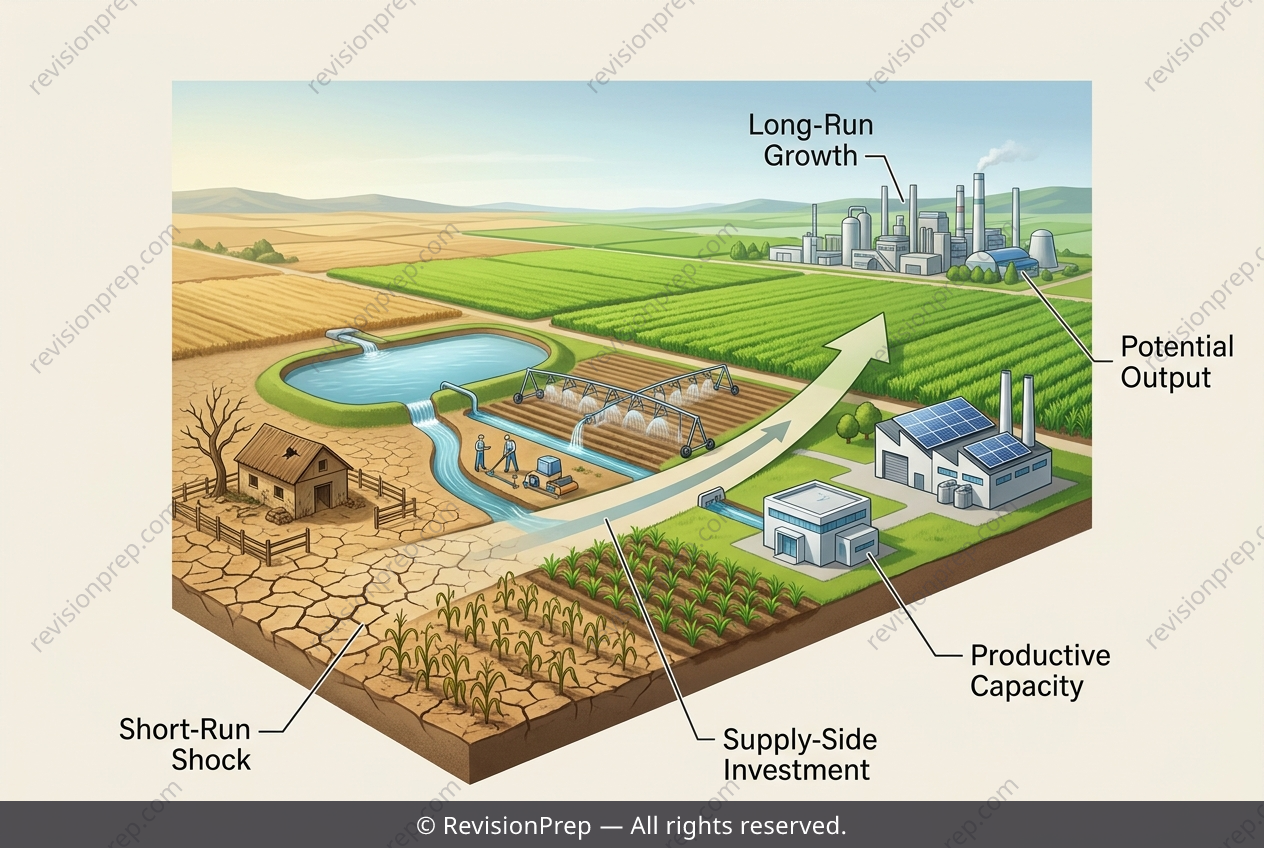
Economics: When Short-Run Shocks Meet Long-Run Growth
Macroeconomics often presents economies with a paradox: short-run shocks and long-run structural change can pull in opposite directions simultaneously. This tension between immediate instability and evolving productive capacity is central to understanding how economies like Country X navigate crises while pursuing growth. Consider an economy hit by a drought that shifts short-run aggregate supply leftward, raising the price level and lowering real GDP — a stagflationary outcome. Meanwhile, an irrigation subsidy raises total factor productivity, shifting long-run aggregate supply rightward and expanding potential output. These opposing forces mean the short-run equilibrium may diverge sharply from the economy's improving long-run trajectory. Expansionary monetary policy can shift aggregate demand rightward to offset output losses, but it cannot accelerate the structural gains from supply-side investment. The interplay between AD, SRAS, and LRAS thus reveals whether stabilisation policy complements or merely masks deeper productive transformation.
Start practising IB questions today
150,000+ IB-styled questions, criteria-mapped and instantly accessible.