
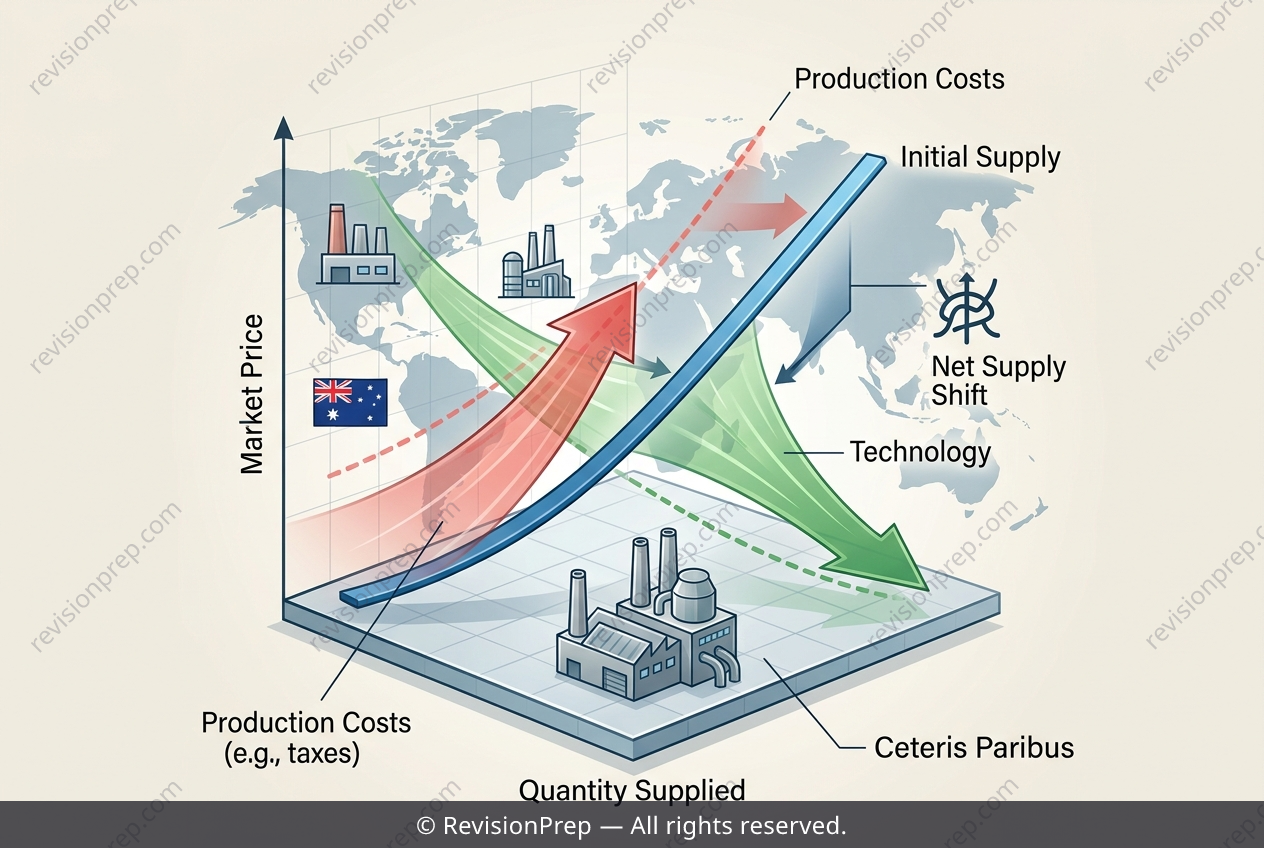
Economics: When Tax and Technology Pull Supply Apart
Non-price determinants of supply are the factors—other than the good’s own price—that shift the entire supply curve, altering the quantity producers are willing to offer at every possible price. While the Law of Supply describes the direct, positive relationship between price and quantity supplied, it holds only under the ceteris paribus assumption, meaning all other influences are held constant. In reality, changes in production costs, technology, taxes, subsidies, or expectations move the curve left or right, fundamentally reshaping market outcomes. This concept matters because real-world markets rarely experience isolated price changes. Consider an Australian aluminium market where producers face a fixed global price of USD 2500 per tonne. A new environmental tax of USD 20 per tonne raises per-unit costs, shrinking profit margins at every price level and shifting supply leftward. Simultaneously, a technological breakthrough cutting electricity use by 15% lowers costs, shifting supply rightward. The net effect on quantity supplied—here reported as a 5% fall—depends on the relative magnitudes of these opposing forces, illustrating how multiple non-price determinants interact to determine final market supply.
Start practising IB questions today
150,000+ IB-styled questions, criteria-mapped and instantly accessible.