
Economics: When Technology Splits a Competitive Market
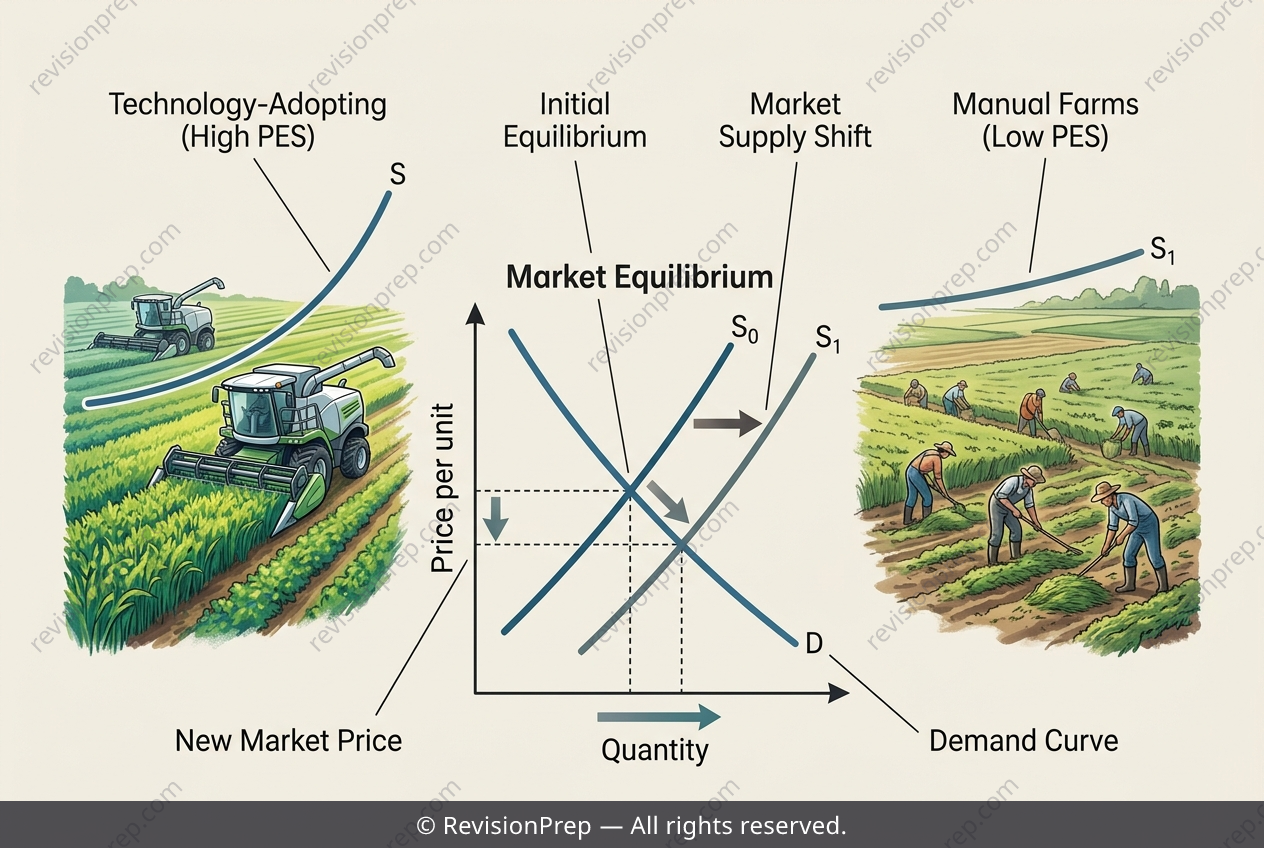
Technological advancement rarely shifts a market evenly—and that unevenness is where the real economic story unfolds. In a competitive market like fresh strawberries, a new automated harvesting technology that cuts picking costs by 30% doesn’t simply lower prices; it splits producers into two camps with vastly different abilities to respond. The core concept here is how a supply-side shock, filtered through price elasticity of demand (PED) and price elasticity of supply (PES), reshapes market equilibrium and determines which firms survive. The key mechanism is the relationship between quantity and price. When overall market supply increases by 12%, the new equilibrium requires quantity demanded to rise by the same amount—so PED = %ΔQd / %ΔP lets you find the resulting price fall. But that price drop hits firms unevenly. Technology-adopting farms, with a high PES of +2.0, can scale output cheaply and quickly, cushioning their revenue. Manual farms, with a low PES of +0.5, can only shrink output by a fraction of the price decline, causing total revenue (TR = P × Q) to contract sharply. Because their costs remain unchanged, their profit margins compress—revealing why technological asymmetry, not just the innovation itself, determines long-run viability in a competitive market.
Start practising IB questions today
150,000+ IB-styled questions, criteria-mapped and instantly accessible.