
Economics: Why GDP Hides the True Cost of Growth
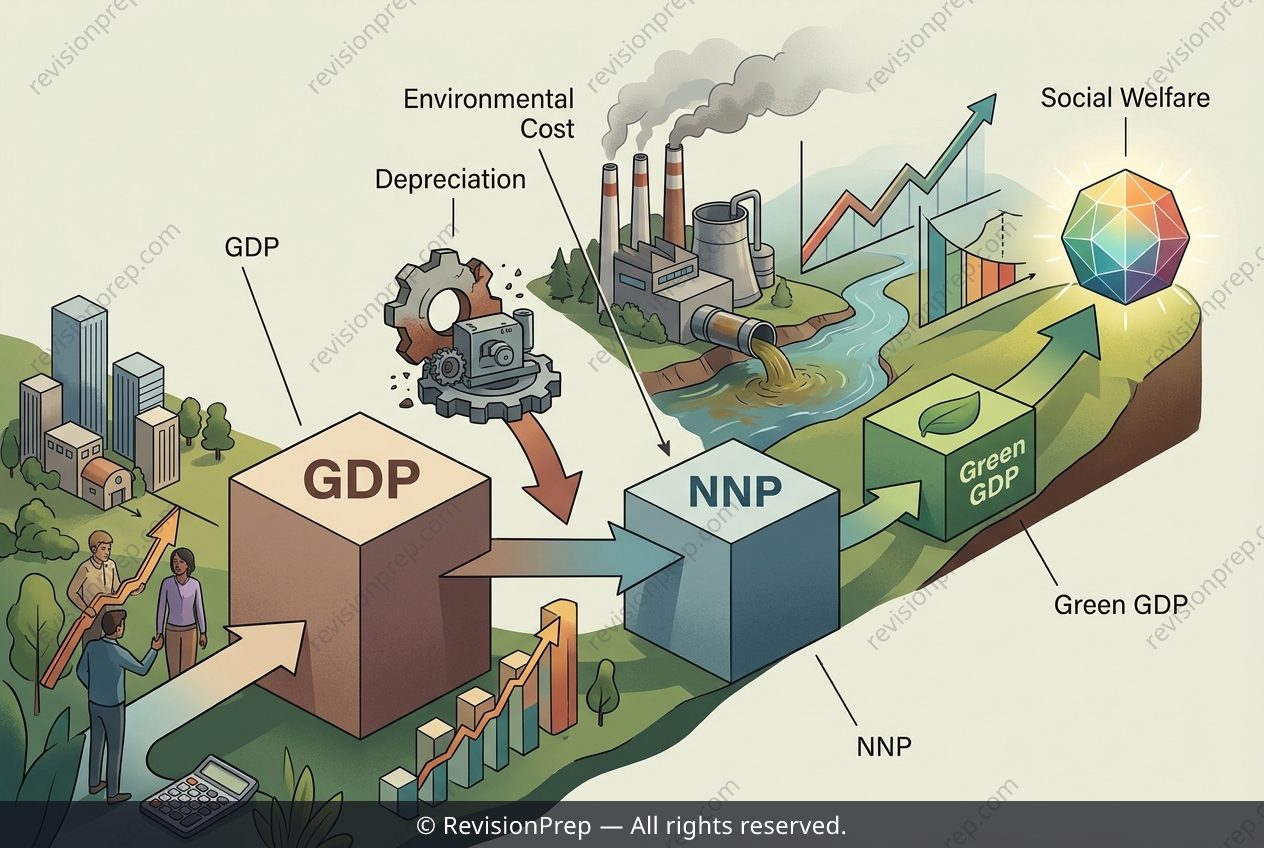
GDP measures the market value of final output, yet it says little about whether that output is sustainable or whether it genuinely improves lives. This topic explores that gap by contrasting nominal GDP with net national product and Green GDP, using Country Z — a newly industrialised Southeast Asian economy — as the worked case. The chain of reasoning runs from depreciation to welfare. Capital stock divided by its average useful life gives annual depreciation, which is subtracted from GDP (equal to GNP here, since net property income from abroad is zero) to yield NNP: 1.2 − 0.4. Green GDP goes further, deducting environmental degradation — pollution costing 3% of GDP — plus any depletion of natural capital. Because steel and chemical plants register as positive output while their health, productivity, and ecosystem costs stay invisible, conventional GDP can overstate progress. Green GDP exposes whether growth is truly sustainable: if pollution costs outpace output, it diverges from GDP, signalling that expansion is eroding long-run welfare.
Start practising IB questions today
150,000+ IB-styled questions, criteria-mapped and instantly accessible.