
Economics: Why Higher Output Doesn't Mean Better Welfare
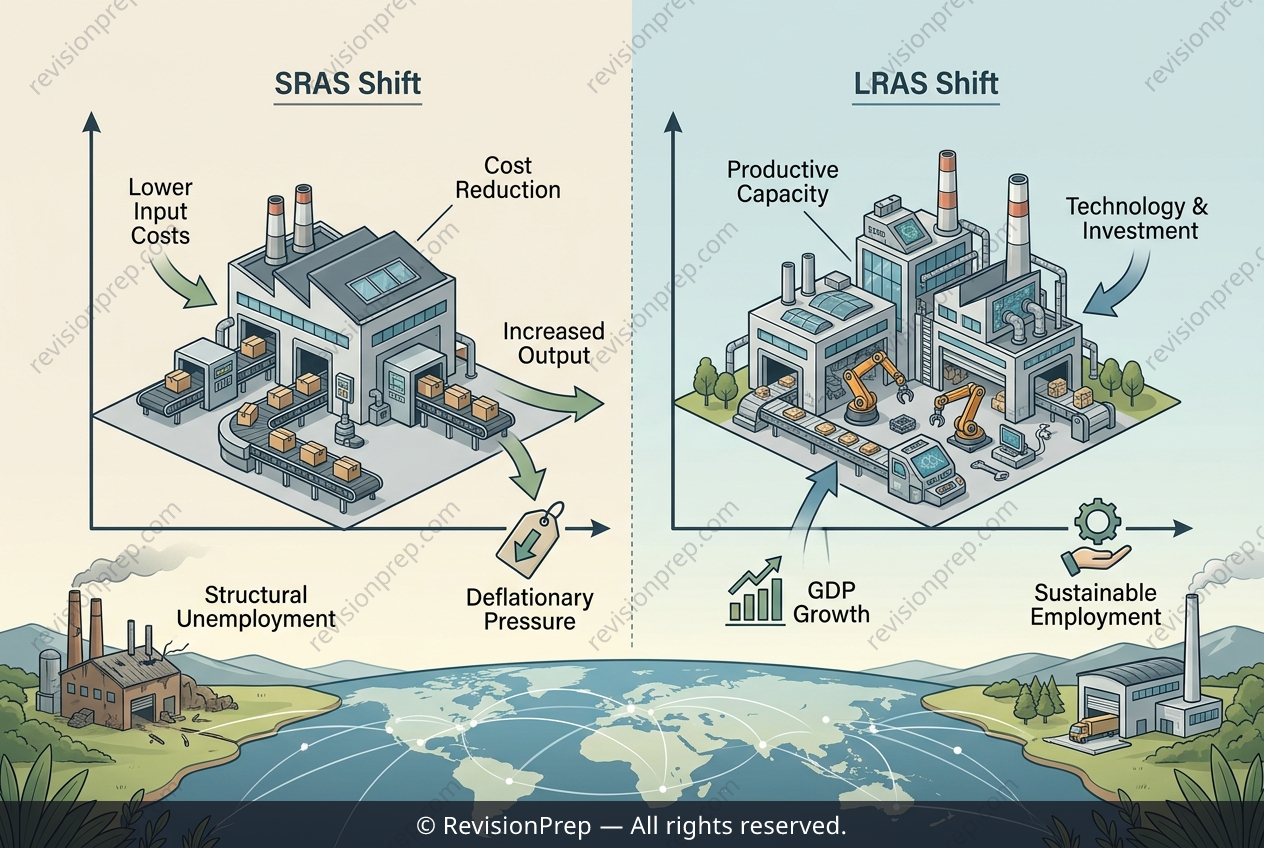
Aggregate supply dynamics sit at the heart of macroeconomic welfare analysis. When SRAS shifts right (SRAS₁ → SRAS₂), equilibrium slides down the AD curve: price level falls and real GDP rises, but only temporarily, since productive capacity is unchanged. When LRAS shifts right instead, full-employment output expands permanently, raising potential GDP without inherent inflationary or deflationary pressure. Why does this distinction matter? Because the underlying cause of an AS increase shapes its welfare consequences. Supply-side gains driven by automation or cheap imports can destroy jobs in specific sectors faster than new ones absorb workers, producing structural unemployment even as output rises. This becomes most likely when labour markets are inflexible — low mobility, skills mismatches, weak retraining — and when expansion concentrates in capital-intensive or import-competing industries. The result: higher output alongside worsening income distribution.
Start practising IB questions today
150,000+ IB-styled questions, criteria-mapped and instantly accessible.