
Economics: Why India's Rate Cut Transmission Failed
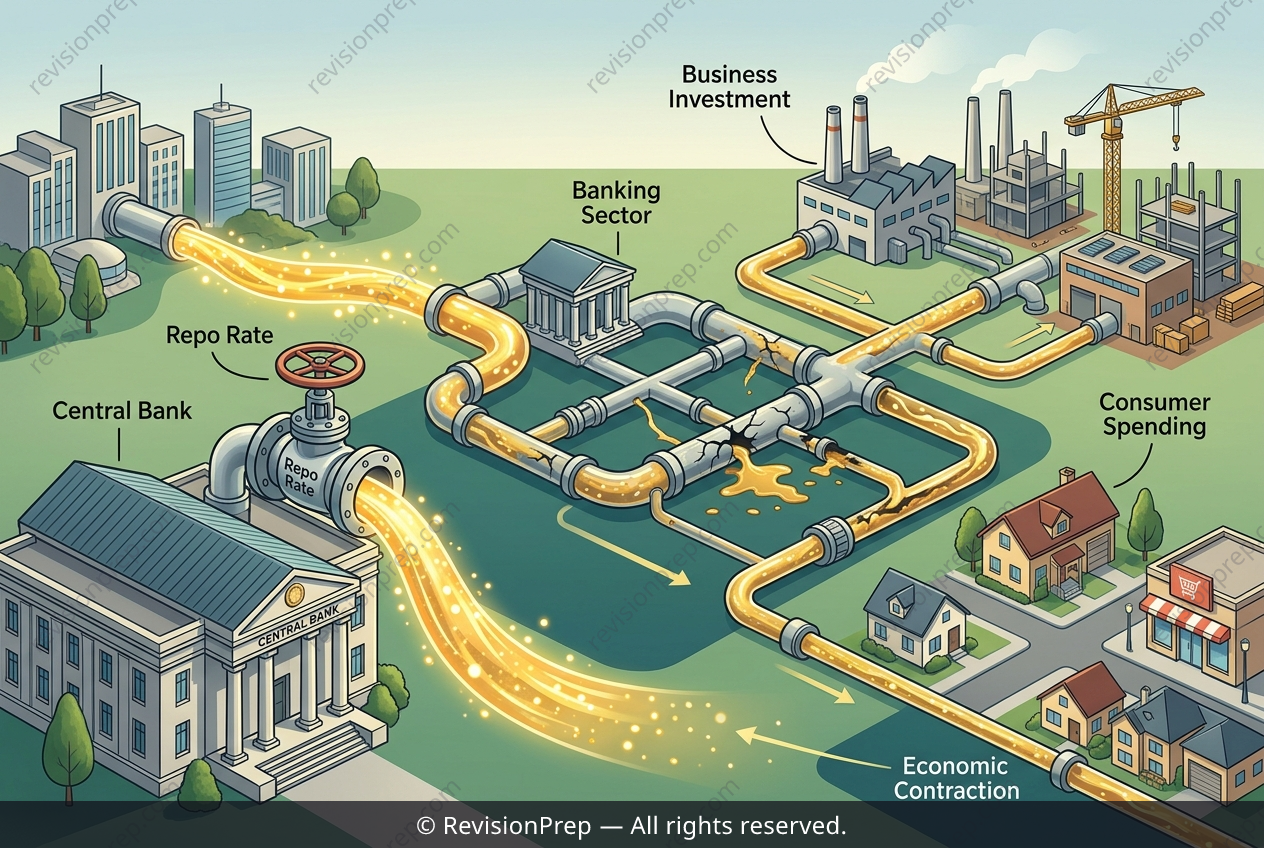
Monetary policy works through a chain of transmission: a central bank lowers its policy rate, commercial banks pass that reduction on to borrowers, and cheaper credit raises consumption (C) and investment (I), shifting aggregate demand rightward. In an AD-AS framework, with downward-sloping AD, upward-sloping SRAS and vertical LRAS, this moves equilibrium from P₁, Y₁ toward P₂, Y₂, narrowing a recessionary gap where Y₁ < Y_f. That chain matters because its links can break. When the Reserve Bank of India cut the repo rate from 5.15% to 4.00% amid a 7.3% GDP contraction and moderate 5.5% inflation, the intended stimulus ran into high non-performing assets, which made banks risk-averse and weakened pass-through to lending rates. Lockdowns and income uncertainty further suppressed loan demand, so firms deferred investment despite cheaper credit. The episode shows why the size of a rate cut says little on its own about the resulting change in real GDP and the price level.
Start practising IB questions today
150,000+ IB-styled questions, criteria-mapped and instantly accessible.