
Economics: Why Markets Undersupply Social Benefits
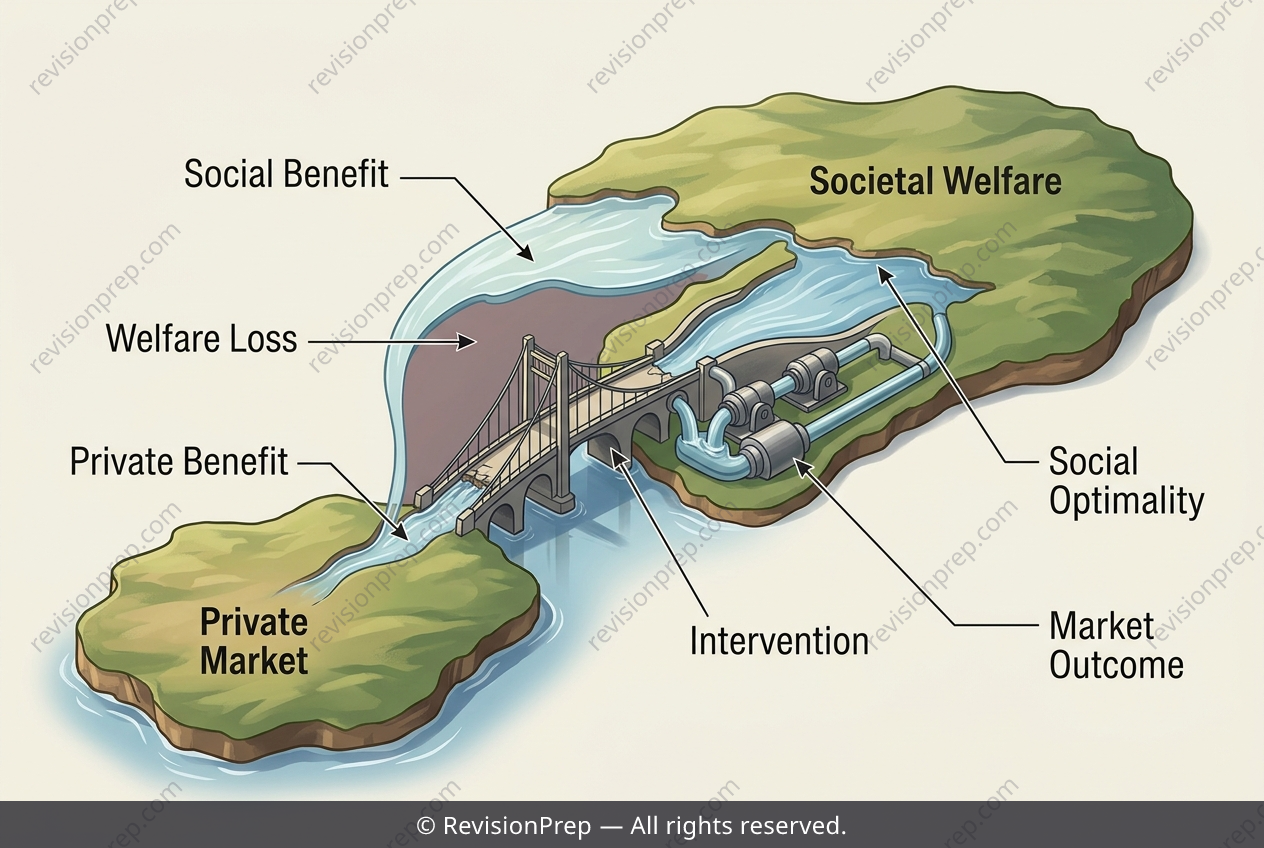
Positive externalities occur when a private action generates benefits enjoyed by others who played no part in the transaction. In microeconomics, this creates a divergence between private and social returns, leading to underproduction by free markets. The mosquito net example in rural Kenya illustrates this perfectly: each net costs USD 5, delivers USD 10 in private benefit (fewer sick days, less household illness), yet confers a far larger social benefit of USD 50 once reduced disease transmission to neighbours and lower public health spending are included. The gap between private and social benefit—here, USD 40 per net—is the external benefit that private firms ignore. Because malaria prevention is non-excludable (you cannot stop a neighbour’s net from protecting you) and non-rivalrous (one household’s protection does not diminish another’s), free-riding suppresses demand. Markets thus supply only a fraction of the socially optimal quantity. Government intervention, such as free universal distribution funded by a broad-based levy, can bridge this gap by aligning consumption with the full social benefit, where marginal social benefit far exceeds marginal cost. Understanding this mechanism—why markets fail and how policy corrects it—is central to evaluating real-world health and environmental interventions.
Start practising IB questions today
150,000+ IB-styled questions, criteria-mapped and instantly accessible.