
Economics: Why “Necessarily” Can Mislead in Markets
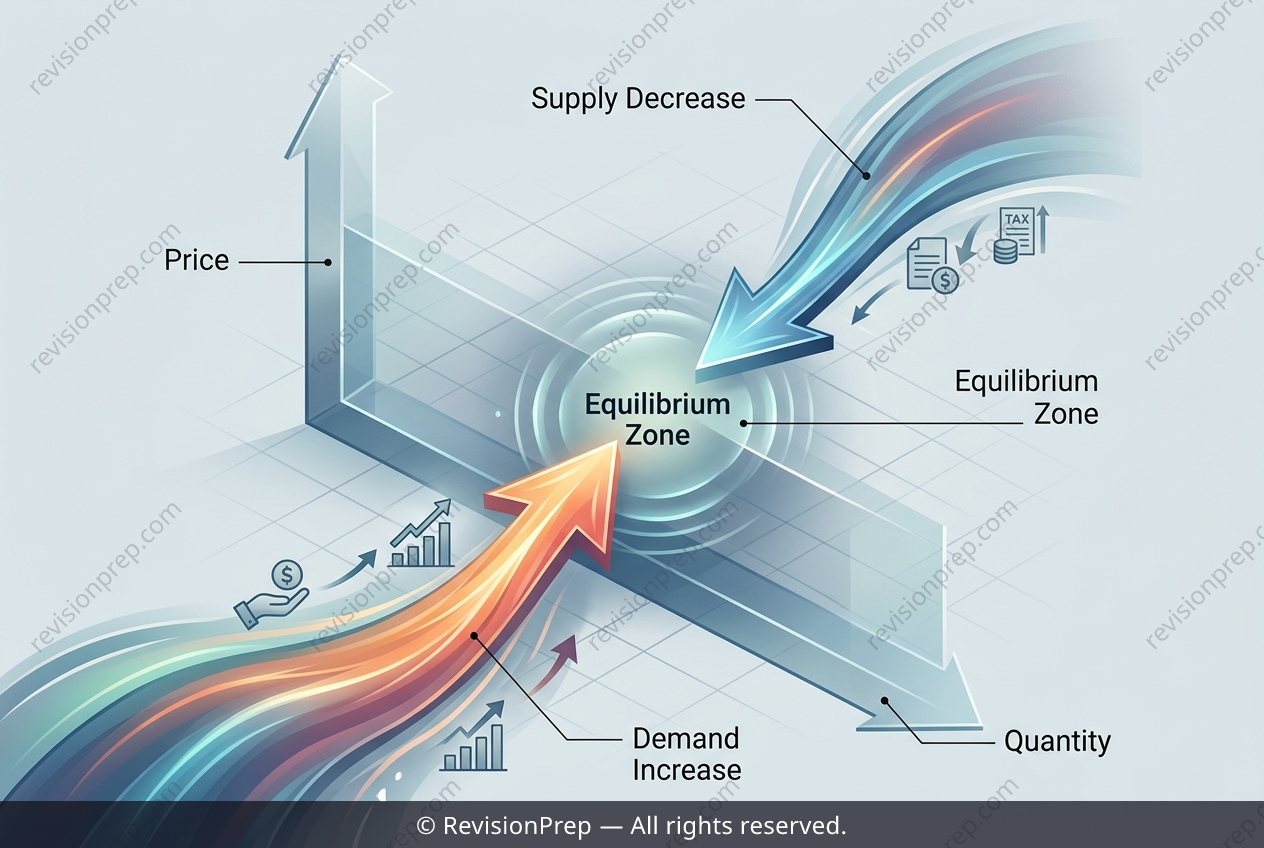
When the Indian government imposed a 5% GST on packaged drinking water in 2023—a product previously untaxed—while urban real incomes simultaneously rose by 8%, the bottled water market became a perfect real-world case of simultaneous shifts in demand and supply. In microeconomics, this is the core challenge: when both curves move at once, you cannot simply read off a single new equilibrium. Instead, you must isolate each shift’s separate effect on price (P) and quantity (Q), then combine them to see which outcome is certain and which is ambiguous. Here, the GST acts as a cost shock: it shifts supply leftward (S → S₁), raising price and lowering quantity. Meanwhile, higher incomes—since bottled water is a normal good—shift demand rightward (D → D₁), raising both price and quantity. The key insight from the marking scheme is that both shifts push price upward, so the net price rise is unambiguous. But quantity is indeterminate: the tax pulls Q down, income pulls Q up, and the final direction depends on the relative magnitudes of each shift—especially how price-sensitive demand is and how much of the tax firms absorb in a competitive market. Understanding this interplay reveals why “necessarily” is a dangerous word in economics.
Start practising IB questions today
150,000+ IB-styled questions, criteria-mapped and instantly accessible.