
Economics: Why PES Changes with Time and Technology
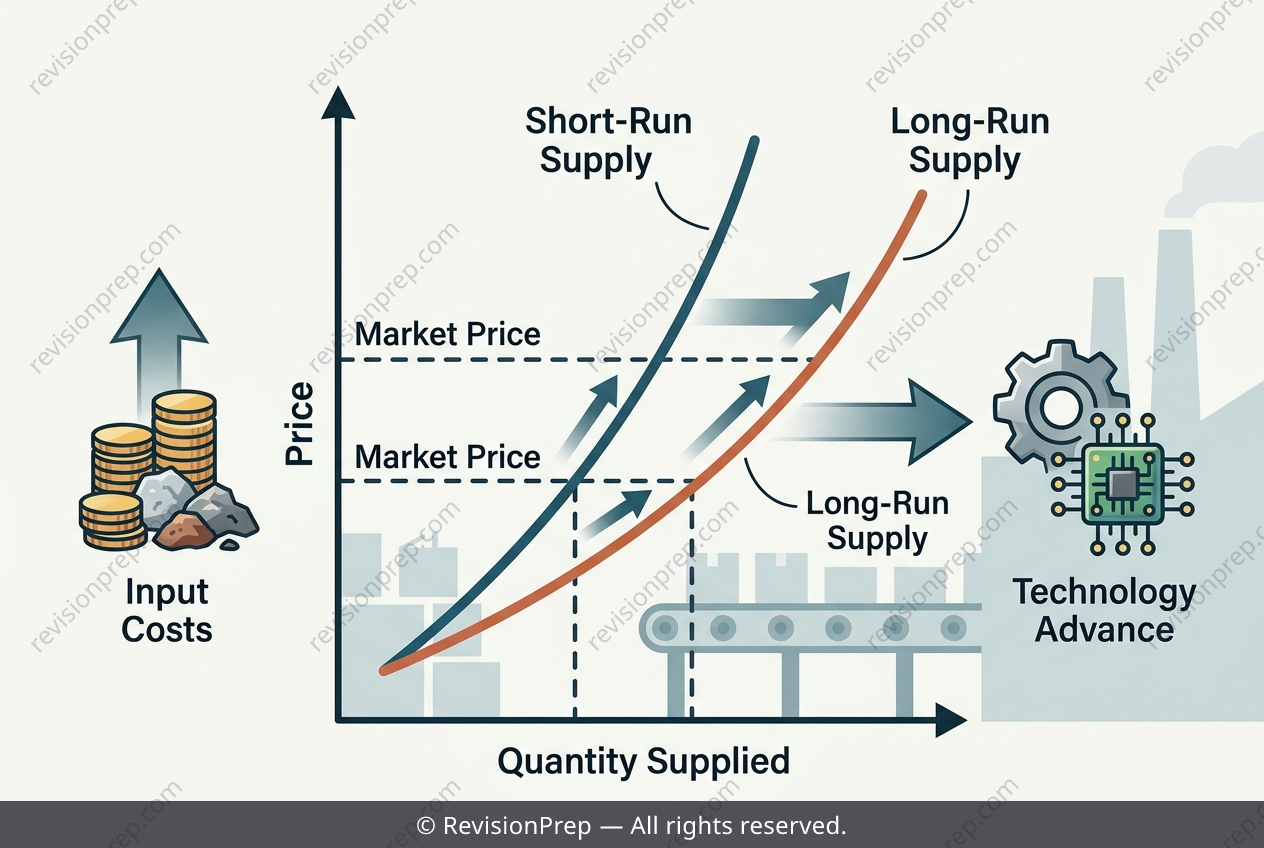
Price elasticity of supply (PES) measures how responsively quantity supplied changes to a change in price — a core tool for understanding how markets adjust to shocks. In microeconomics, PES is not a fixed number; it depends on time horizons, production flexibility, and the structure of input costs. For students of Economics HL, mastering PES means seeing beyond simple percentage shifts and into the underlying dynamics of supply curves — why they move, how steeply they slope, and what forces can push them left or right simultaneously. The semiconductor chip market offers a vivid case study. When the price of a standard wafer jumps by 50%, the short-run quantity supplied rises by only a fraction of that (PES = 0.4), reflecting rigid capacity and input bottlenecks. Yet supply is not static: a rise in polysilicon costs shifts the supply curve leftward, while a new fabrication process that cuts defective chips by 30% shifts it rightward — the net effect depends on which force dominates. Over the long run, PES climbs above 1, as firms expand plants and source alternatives, making supply far more elastic. This interplay between price signals, cost shocks, and technology is the heart of supply dynamics — and why PES matters for predicting real-world market outcomes.
Start practising IB questions today
150,000+ IB-styled questions, criteria-mapped and instantly accessible.