
Economics: Why Stagflation Traps Central Banks
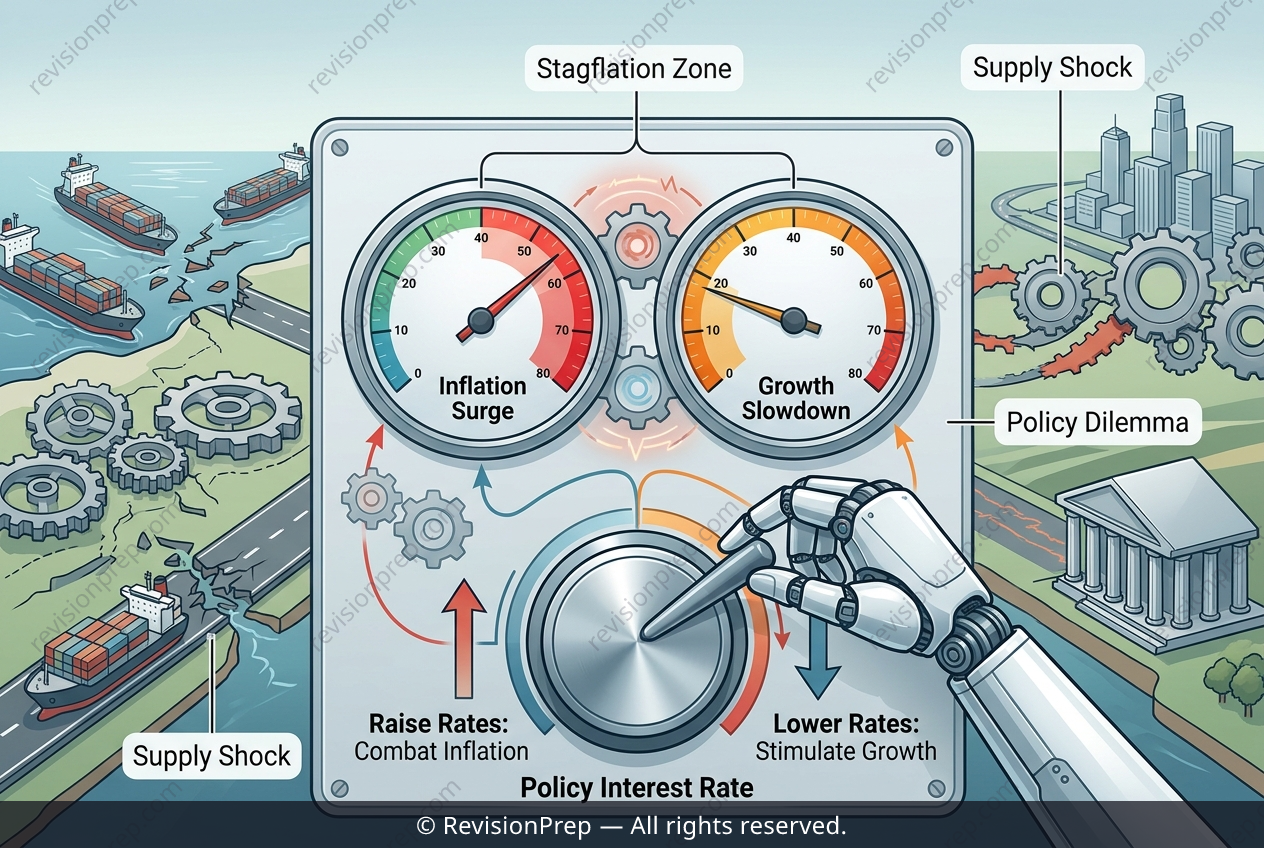
Stagflation occurs when an economy faces rising inflation alongside falling output, a combination that forces central banks into uncomfortable trade-offs. In Country X, a global supply chain disruption raises firms' production costs, shifting short-run aggregate supply leftward from SRAS₁ to SRAS₂ while aggregate demand and long-run aggregate supply stay put. The new equilibrium brings a higher price level and lower real output, opening a recessionary gap where Y₂ falls below full-employment output Yf. This matters because the central bank's usual tools pull in opposite directions: raising interest rates to curb inflation risks deepening the slowdown, while cutting rates to support growth could entrench inflation further. The debate hinges on whether sustained inflation erodes real incomes and unanchors expectations, or whether prioritising disinflation inflicts unnecessary short-run output losses. Understanding how SRAS shocks propagate through the price level and real GDP is essential to evaluating any policy response.
Start practising IB questions today
150,000+ IB-styled questions, criteria-mapped and instantly accessible.