
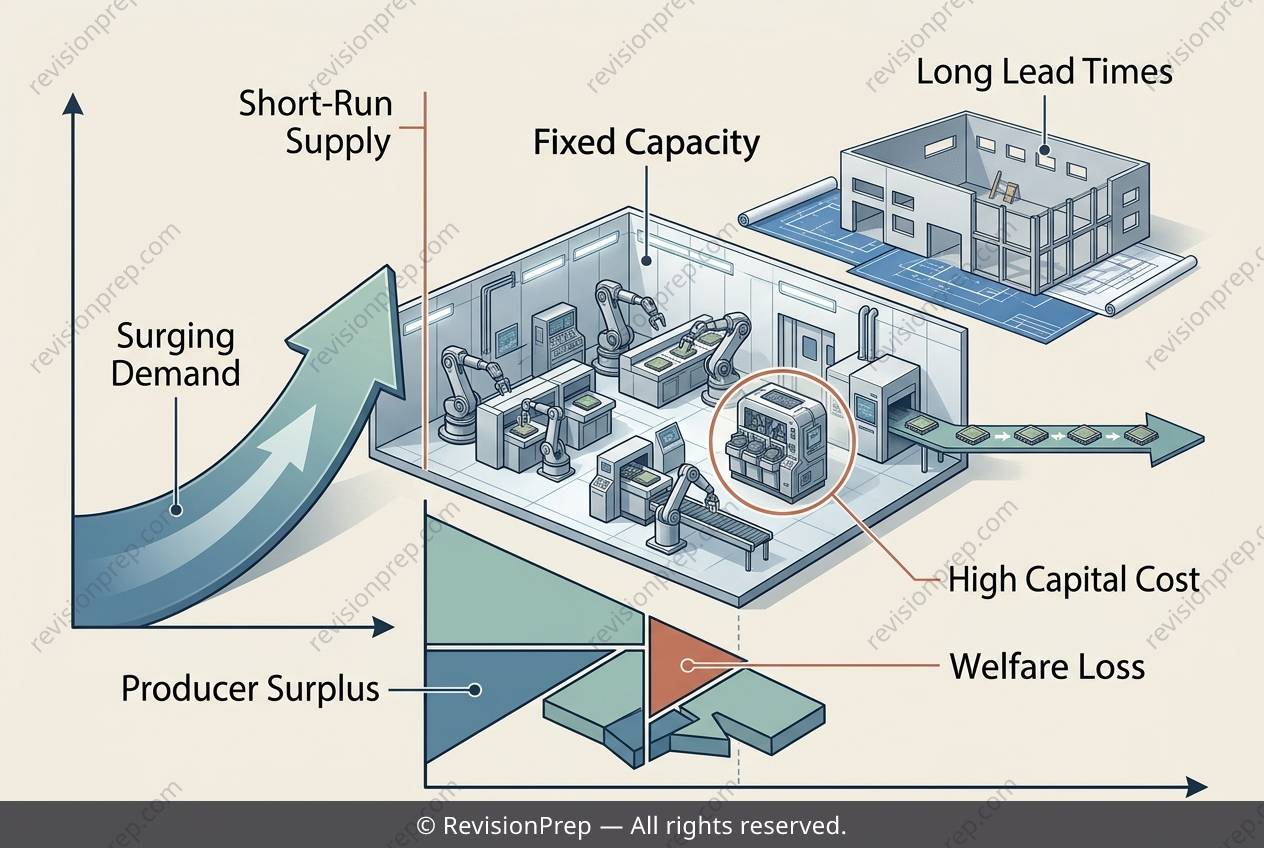
Economics: Why Supply Cannot Catch Up with Demand
Price Elasticity of Supply (PES) measures how responsive the quantity supplied of a good is to a change in its price. It is calculated as the percentage change in quantity supplied divided by the percentage change in price, giving a coefficient that tells us whether supply is elastic (PES > 1), inelastic (PES < 1), or unit elastic (PES = 1). This concept matters because it determines how quickly and effectively markets can adjust to demand shocks, directly influencing price volatility, producer revenue, and consumer welfare. The semiconductor shortage of 2020–2022 is a perfect illustration of inelastic supply in action. When demand surged, a 10% price increase yielded only a 2% rise in quantity supplied within the first year, reflecting a PES of 0.2. The two key determinants at play were time—new fabrication plants take years to build—and the absence of spare capacity, as existing plants already ran at maximum output. These constraints mean that price signals alone cannot quickly bring forth more supply, forcing the market to ration through higher prices rather than increased production. Understanding PES thus reveals why some industries suffer prolonged shortages while others adjust smoothly.
Start practising IB questions today
150,000+ IB-styled questions, criteria-mapped and instantly accessible.