
Economics: Why Supply Elasticity Changes Over Time
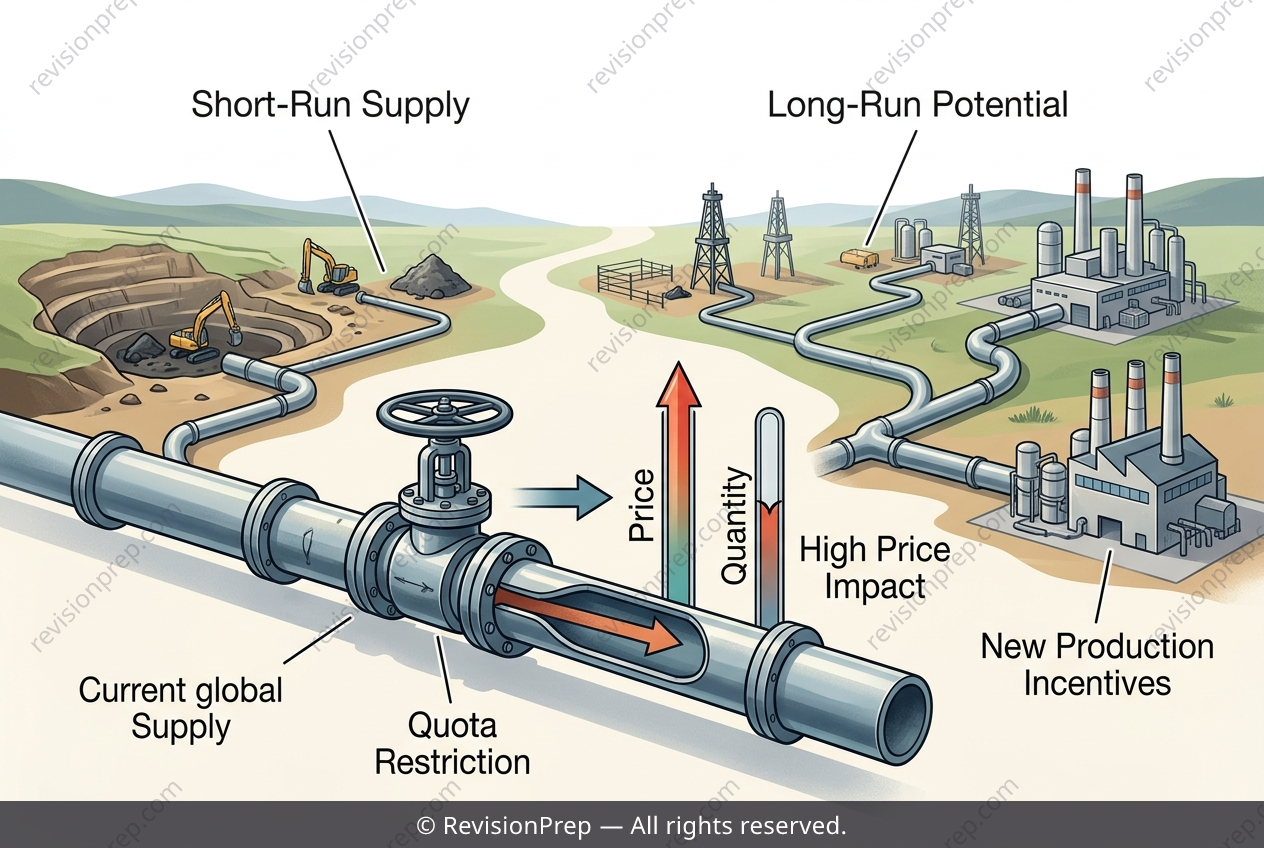
When China restricts exports of rare earth elements, the immediate shock to global markets is not just about fewer tonnes of neodymium—it’s about how violently prices react to that shortage. That reaction hinges on Price Elasticity of Supply (PES), which measures the responsiveness of quantity supplied to a change in price, calculated as PES = %ΔQs / %ΔP. In the short run, REE supply is deeply inelastic: contracts are locked in for 6–12 months, and no new mines can open overnight. So when the supply curve shifts left due to an export quota, the price spikes far more than the quantity traded falls—a large vertical jump along a steep supply curve, moving equilibrium from (P₁, Q₁) to (P₂, Q₂) with P₂ >> P₁. This matters because PES is not static—it stretches over time. The same quota that causes a 40% price surge today also sends a powerful long-term signal. Over 7–10 years, higher prices incentivise new mining projects in Australia and the USA, boost recycling, and encourage substitution in battery and turbine manufacturing. As these alternatives come online, PES rises toward elastic, meaning future supply shocks will cause smaller price swings and gradually erode China’s pricing power. Understanding this dynamic—how a steep short-run supply curve flattens into a more responsive one—reveals why trade policy, market power, and time horizons are inseparable in microeconomics.
Start practising IB questions today
150,000+ IB-styled questions, criteria-mapped and instantly accessible.