
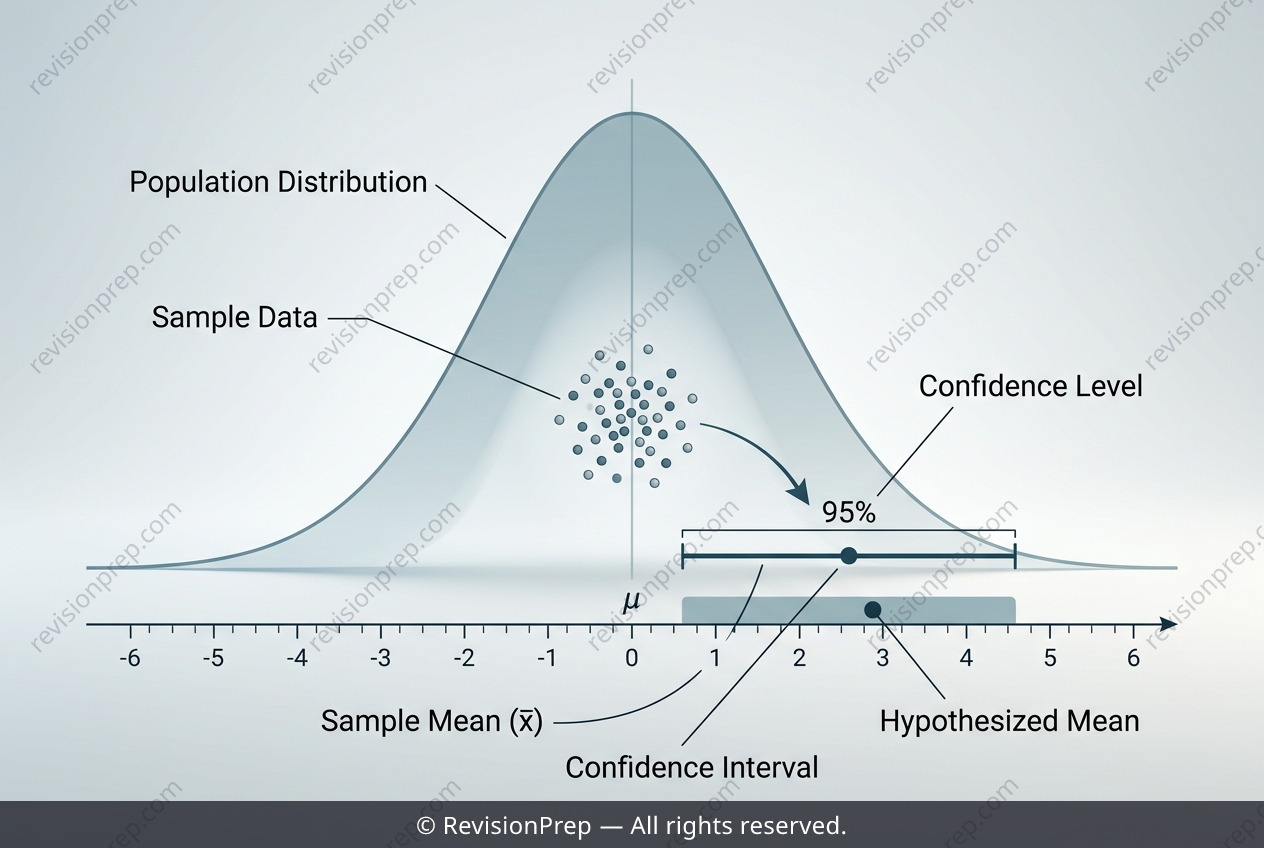
Maths: Building a t-Based Confidence Interval
Confidence intervals are one of the most powerful tools in statistics: they give a range of plausible values for a population parameter when you only have data from a sample. In this case, we’re estimating the true mean length of factory-produced metal rods from just 12 measurements. Because the population standard deviation is unknown and the sample is small, we don’t use the normal distribution—instead, we rely on the t-distribution, which accounts for the extra uncertainty introduced by estimating the standard deviation from the sample itself. The key relationship here is that the interval is built around the sample mean, x̄, and extends by a margin of error equal to t × (s / √n), where s is the sample standard deviation (calculated with n – 1 in the denominator) and n is the sample size. The critical t-value depends on the confidence level (95%) and the degrees of freedom (n – 1 = 11). This interval then lets us judge claims: if a proposed mean (like 150 mm) falls inside the interval, the data support it; if a specification range (like 149–151 mm) contains the entire interval, the process meets that requirement. Understanding how these pieces fit—sample mean, spread, sample size, and the t-multiplier—is what turns raw data into a defensible conclusion.
Start practising IB questions today
150,000+ IB-styled questions, criteria-mapped and instantly accessible.