
Maths: Differential Equations and Terminal Velocity
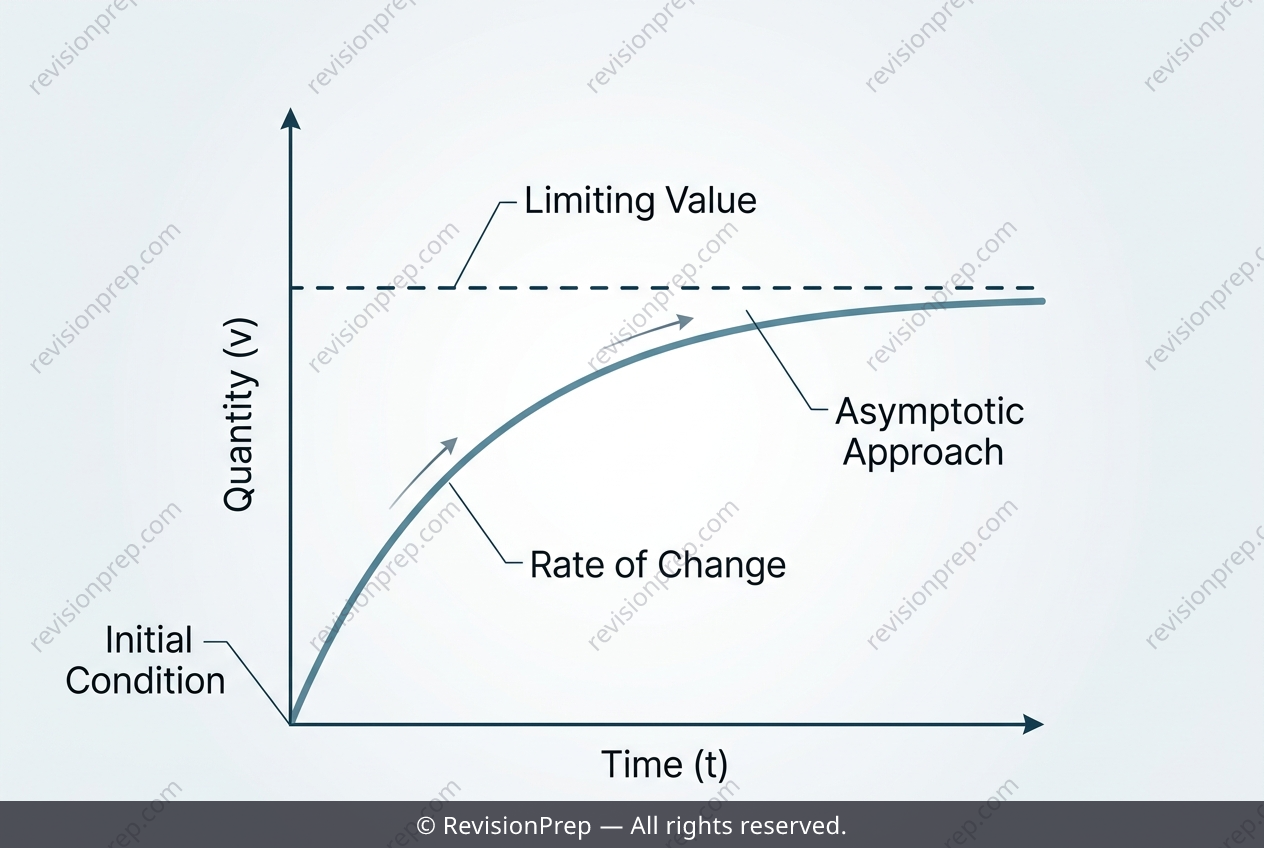
Differential equations let us describe how a system changes moment by moment, and solving one reveals the entire future path of that system. In this case, the velocity of a particle obeys dv/dt = 4 − 0.5v, a first-order linear equation where the rate of change depends on the current velocity itself. This creates a self-correcting feedback loop: as v grows, the term 0.5v slows further increase, pushing the particle toward a stable equilibrium. The proposed solution v = 8(1 − e^(−0.5t)) elegantly captures this behaviour. Differentiating it gives 4e^(−0.5t), which exactly matches the right-hand side after substitution — verifying the equation. At t = 0, the exponential term equals 1, so v = 0, satisfying the initial rest condition. The structure of the solution shows two key ideas: the constant 8 represents the limiting velocity (where dv/dt = 0), and the exponential decay term e^(−0.5t) controls how quickly the particle approaches that limit. Because the approach is asymptotic, the particle never quite reaches 8 m/s, but it gets arbitrarily close. Understanding this relationship between the differential equation, its solution, and the long-term behaviour is central to modelling real-world processes like cooling, population growth, or terminal velocity.
Start practising IB questions today
150,000+ IB-styled questions, criteria-mapped and instantly accessible.