
Maths: How a Fractal Tree Creates a Divergent Series
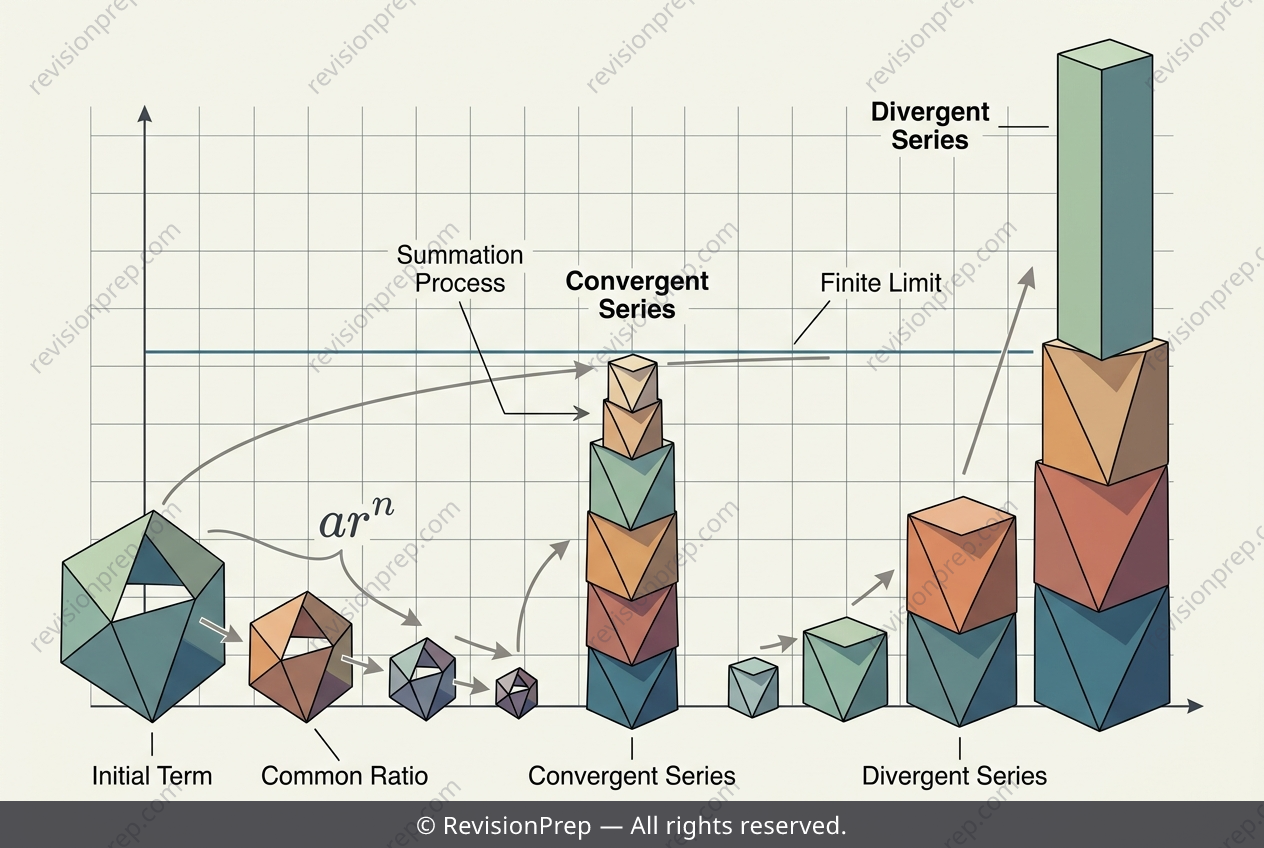
Geometric sequences and series describe situations where each term is found by multiplying the previous one by a fixed common ratio, r. When r is greater than 1, terms grow and the sum diverges; when r lies between -1 and 1, terms shrink toward zero and the infinite sum converges to a finite value using S∞ = u1 / (1 - r). This distinction between convergence and divergence is central to understanding how a process behaves over the long run. The fractal tree problem brings these ideas together. Each stage adds 2^n branches of length 0.6^n, so the total length added at stage n is 1.2^n, forming a geometric series with r = 1.2. Because this ratio exceeds 1, the series diverges, meaning the total length keeps growing without bound. The same structure also lets you find partial sums with Sn = u1(r^n - 1)/(r - 1), or work backwards to find when individual branch lengths fall below a given threshold.
Start practising IB questions today
150,000+ IB-styled questions, criteria-mapped and instantly accessible.