
Maths: How Derivatives Find a Drug’s Peak Concentration
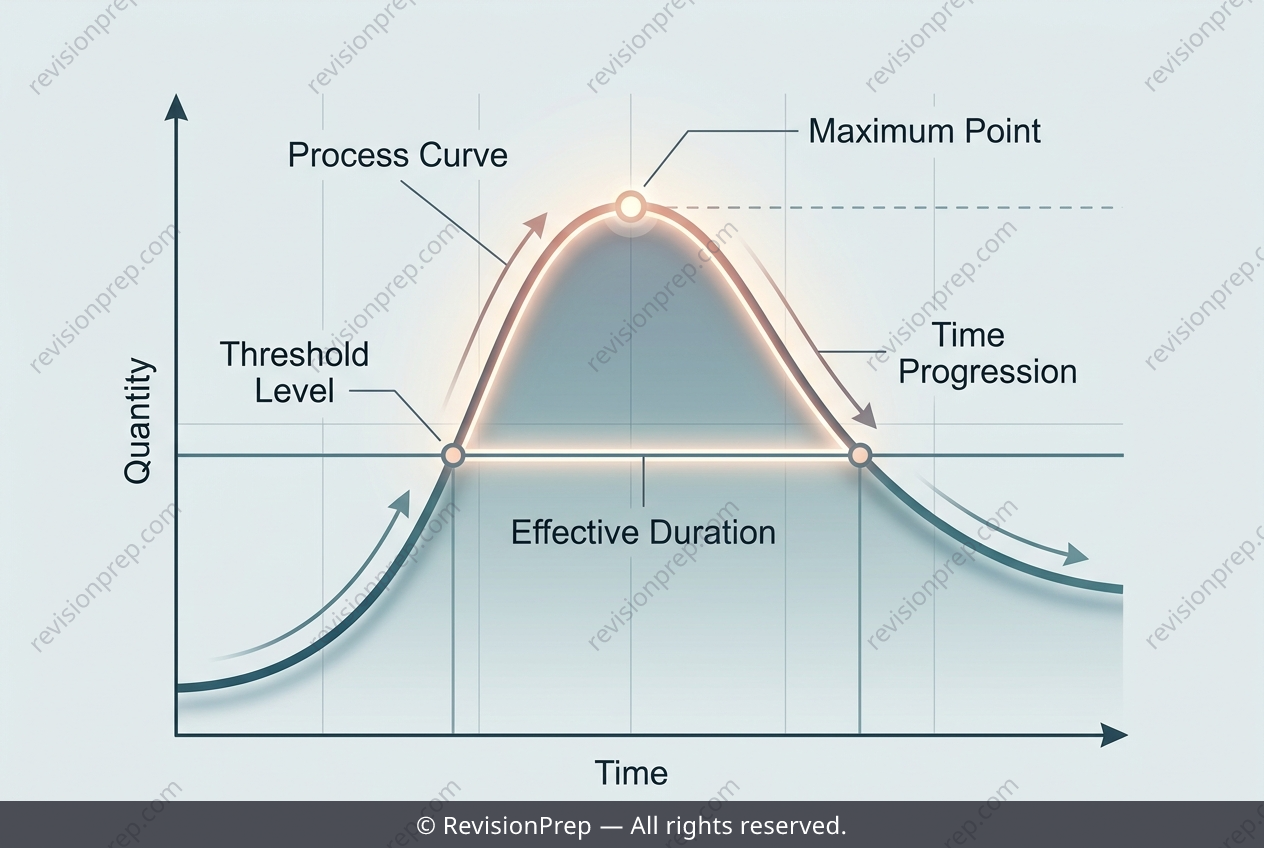
Optimisation sits at the heart of calculus: finding where a quantity peaks, dips, or crosses a threshold. In this problem, a drug's concentration in the bloodstream is modelled by C(t) = 5(e^(−0.2t) − e^(−0.8t)), a function that rises as the drug enters the system, then decays as the body clears it. The result is a single, well-defined maximum — the moment the drug is most potent. To locate it, we differentiate to get C′(t) = 5(−0.2e^(−0.2t) + 0.8e^(−0.8t)), set the derivative to zero, and solve. The exponential terms collapse neatly into e^(0.6t) = 4, giving an exact time in terms of ln 4. Substituting this back into C(t) yields the peak concentration, while solving C(t) = 1.5 identifies the two times the drug crosses the effective threshold — the gap between them being the total effective duration.
Start practising IB questions today
150,000+ IB-styled questions, criteria-mapped and instantly accessible.