
Maths: How Factor Theorem Links Algebra to Geometry
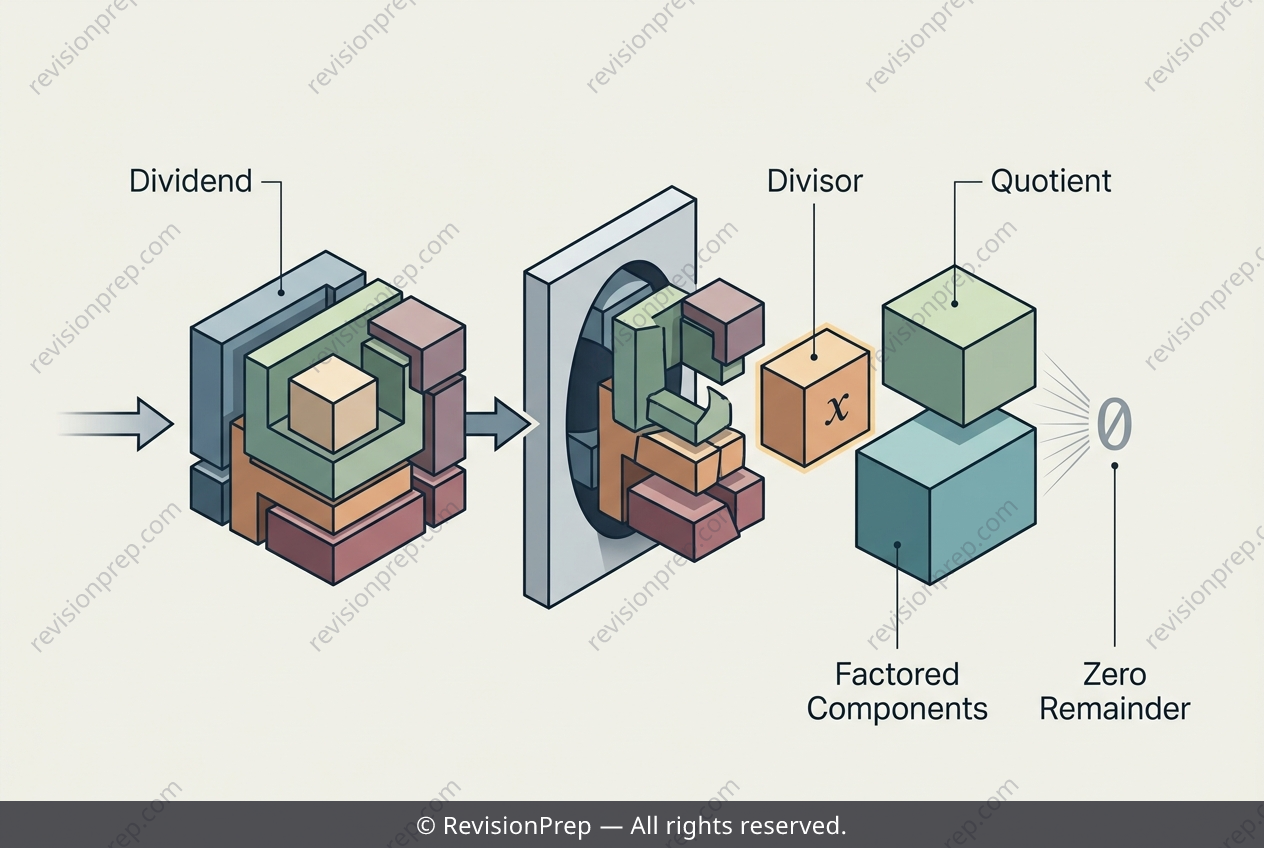
Polynomial factorization and division sit at the heart of Number and Algebra, linking the roots of a polynomial to the linear factors that build it. The Factor Theorem captures this relationship neatly: if substituting a value a into V(x) gives zero, then (x − a) must divide the polynomial exactly, leaving no remainder. This turns a seemingly abstract expression into a product of simpler pieces. That idea matters because factorising a cubic reveals structure hidden in its expanded form. Dividing V(x) by a known factor produces a quadratic quotient, which can often be factorised further into two linear factors. Each factor then represents a real quantity — here, the three dimensions of a rectangular box, since volume equals length times width times height. Recognising how the Factor Theorem, polynomial division, and factorisation chain together lets you move fluidly between a polynomial's algebraic form and its geometric meaning.
Start practising IB questions today
150,000+ IB-styled questions, criteria-mapped and instantly accessible.