
Maths: How Factors Define Rational Function Graphs
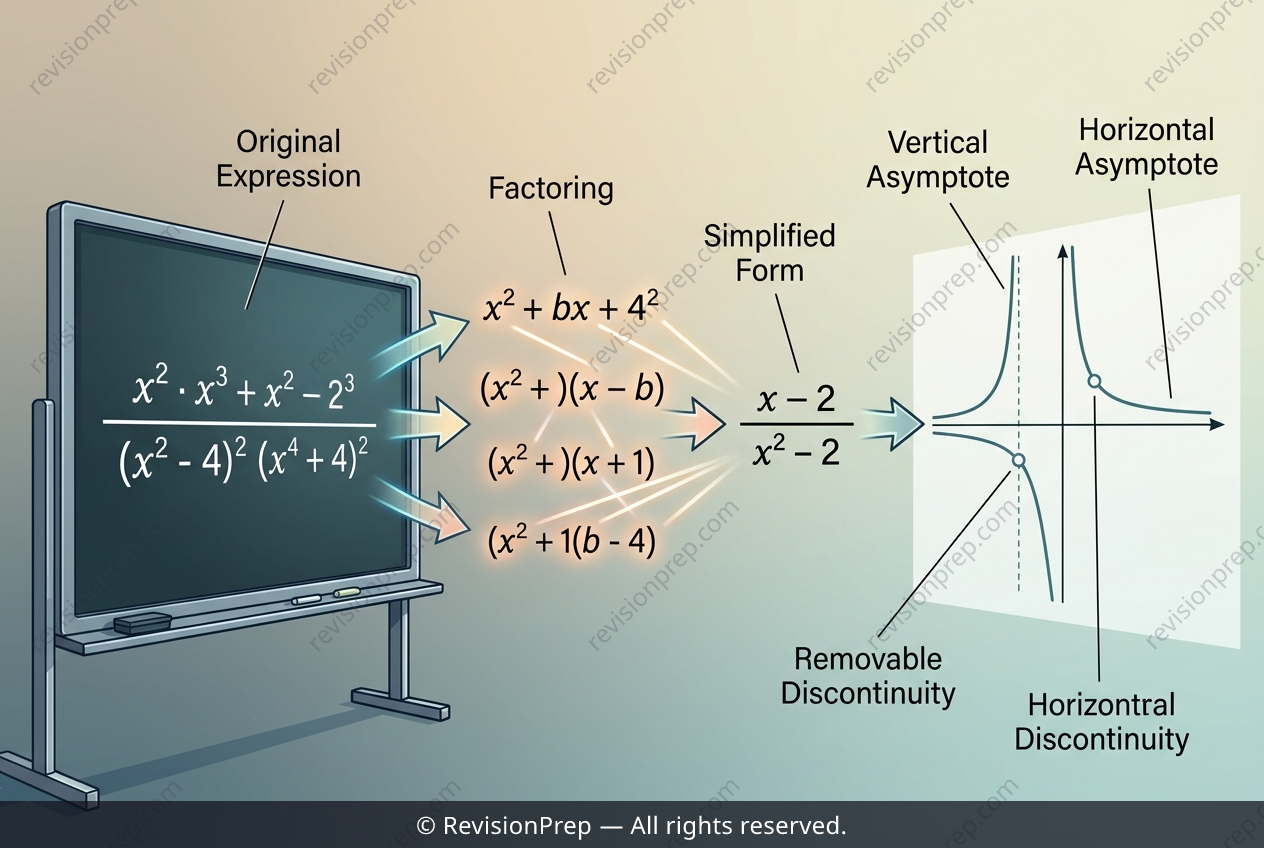
Rational functions describe how one polynomial divides another, and their behaviour is shaped by the factors hiding inside both. Factorising the numerator and denominator of an expression like (x² − 4)/(x² − x − 6) reveals shared structure: here (x − 2)(x + 2) over (x − 3)(x + 2). Cancelling a common factor simplifies the function, but only where that factor is nonzero — the excluded x-value leaves a hole, not a true asymptote. This distinction matters because each feature of a rational function tells a different story about its graph. A factor that cancels creates a point discontinuity, while a factor remaining in the denominator drives a vertical asymptote. Meanwhile, comparing the leading terms of numerator and denominator governs end behaviour, since dividing through by the highest power of x shows the ratio settling toward a constant. Together, simplification, domain restrictions, and limits give a complete picture of the function.
Start practising IB questions today
150,000+ IB-styled questions, criteria-mapped and instantly accessible.