
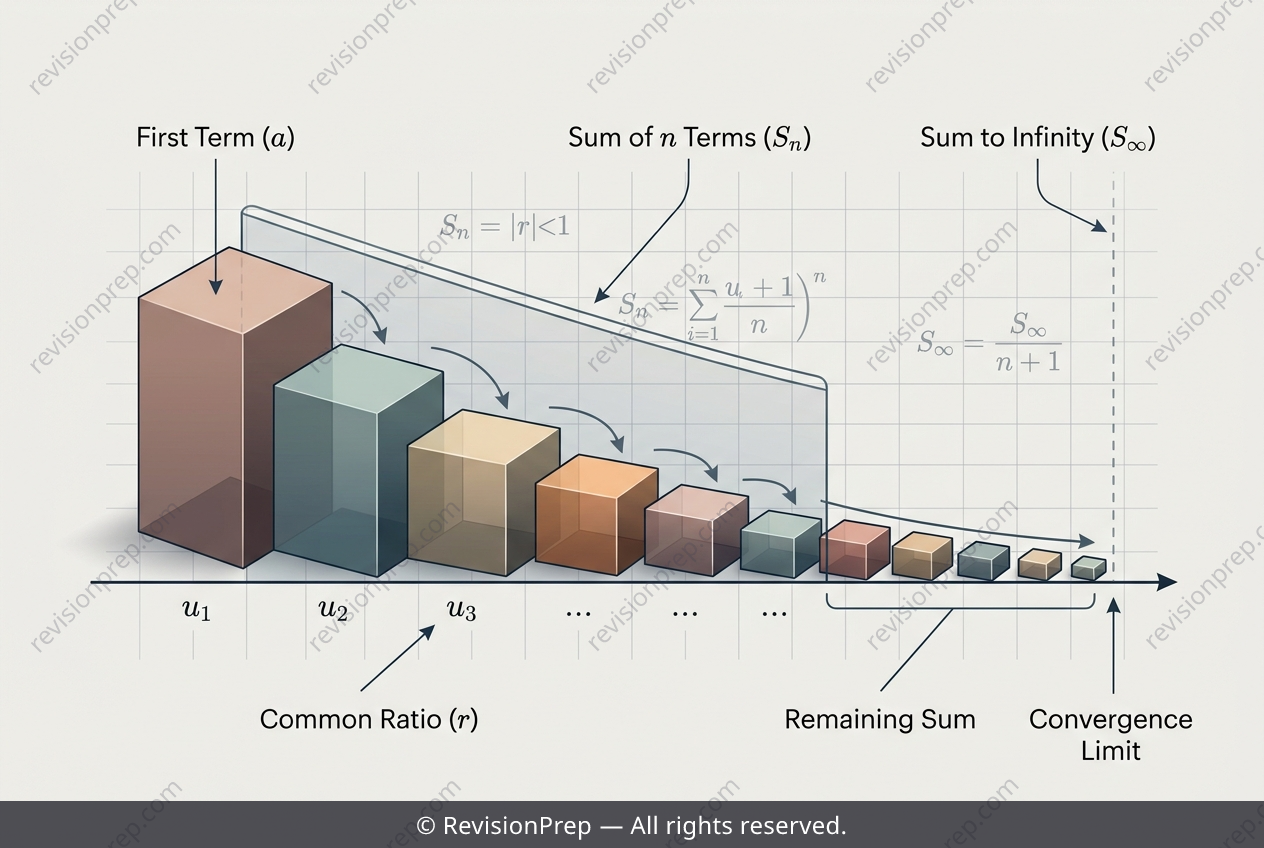
Maths: How Geometric Series Lead to Infinite Sums
Geometric series sit at the heart of Number and Algebra, describing sequences where each term is found by multiplying the previous one by a fixed common ratio, r. This post explores how the sum of the first n terms, Sn, is derived by writing out the series, multiplying by r, and subtracting to eliminate the middle terms, leaving Sn(1 − r) = a(1 − rⁿ) and hence Sn = a(1 − rⁿ)/(1 − r). Understanding this derivation reveals why the formula behaves as it does. The concept matters because it connects finite sums to infinite behaviour. When |r| < 1, rⁿ shrinks towards zero, so the sum to infinity converges neatly to S∞ = a/(1 − r). The difference between this limiting sum and a partial sum, S∞ − Tn, therefore depends on how quickly rⁿ decays — a relationship that links the algebra of the derivation to exponential decay and inequalities involving logarithms.
Start practising IB questions today
150,000+ IB-styled questions, criteria-mapped and instantly accessible.