
Maths: Why the Initial Ball Drop Isn't in the Series
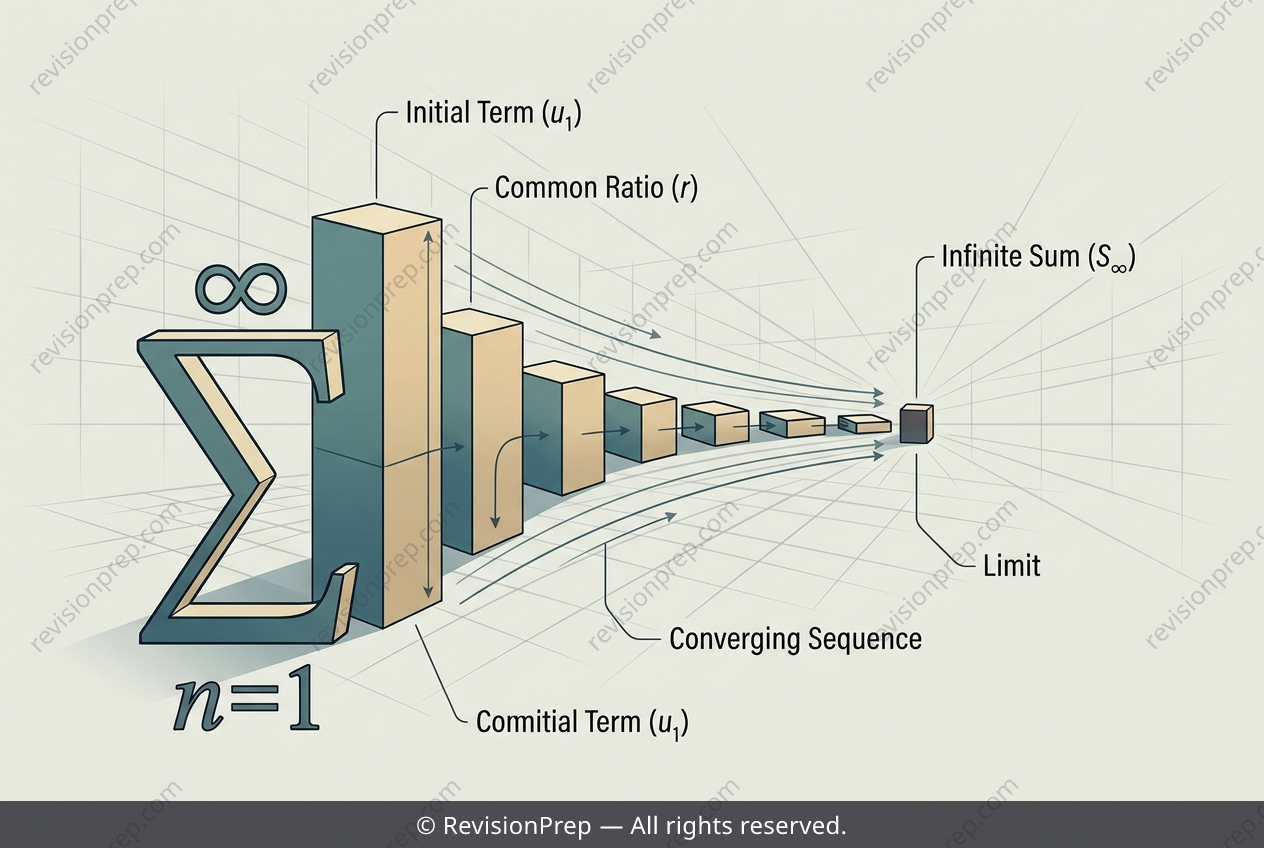
The sum to infinity of a geometric series captures what happens when a process repeats forever but each repetition shrinks by a fixed ratio. When the common ratio r satisfies |r| < 1, the terms fade toward zero and the running total settles on a finite value, given by S∞ = u₁ / (1 − r). This idea matters because it turns an infinite sequence of steps into a single, measurable quantity — something finite emerging from endless repetition. The key is recognising the structure: a first term u₁, a constant multiplier r, and the condition |r| < 1 that guarantees convergence. In the bouncing-ball problem, each bounce contributes an up-and-down pair, so these paired distances form their own geometric series with a first term and ratio derived from the bounce height. The initial drop is separate, since it happens only once. Combining that one-off distance with the infinite sum gives the total vertical distance travelled.
Start practising IB questions today
150,000+ IB-styled questions, criteria-mapped and instantly accessible.