
Maths: Why Each Bounce Distance Is Counted Twice
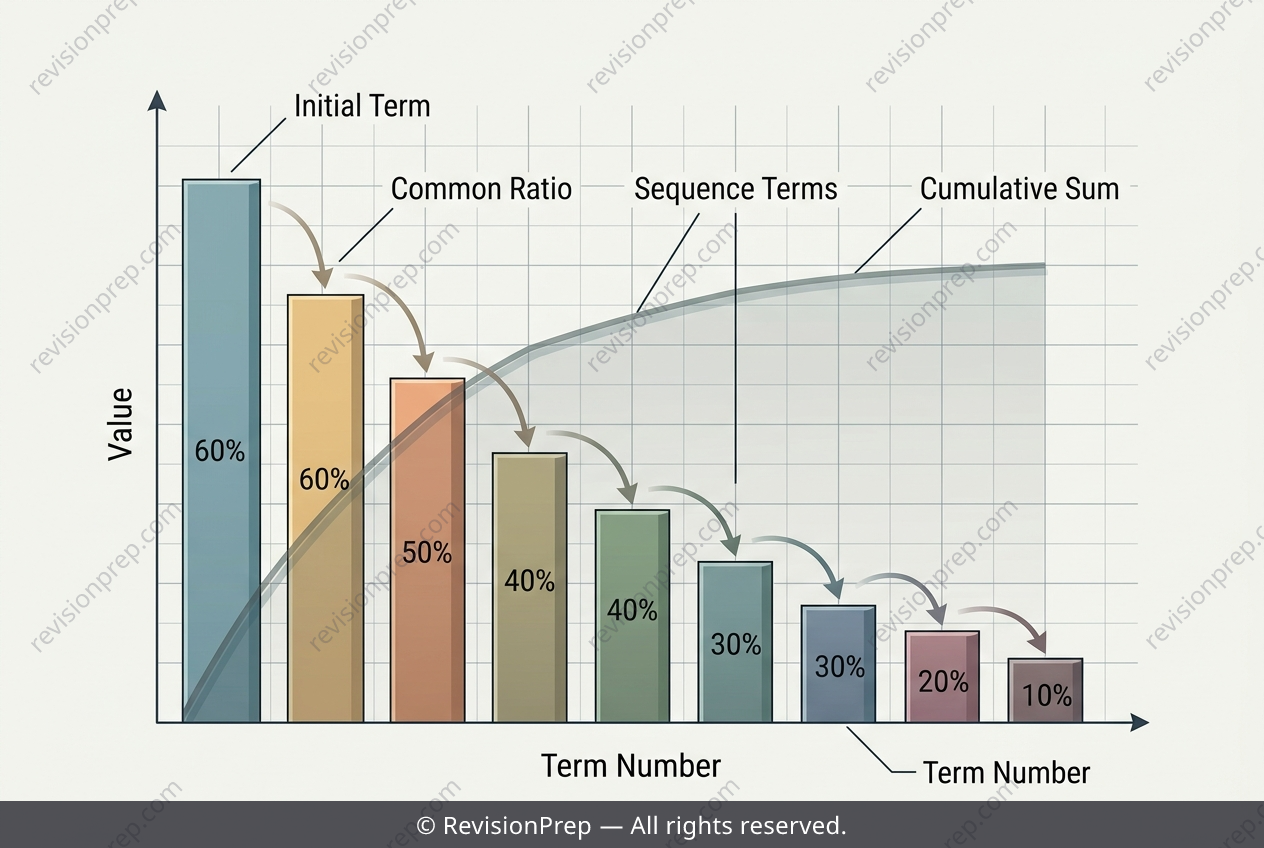
Geometric sequences describe quantities that change by a constant multiplier at each step, and they appear everywhere from population growth to the bouncing of a ball. When a ball is dropped and rebounds to a fixed fraction of its previous height, the successive heights form a geometric sequence with first term u₁ and common ratio r, while the total distance travelled becomes a geometric series built from those heights. What makes this topic powerful is how neatly the parts connect. The nth term, uₙ = u₁r^(n−1), tracks any single bounce height, and the finite sum formula, Sₙ = u₁(rⁿ − 1)/(r − 1), adds a run of them together. Because the ball rises and falls along each bounce, distances are often counted twice, so careful bookkeeping matters: the initial drop, the upward rebounds, and the matching downward journeys each contribute. Recognising which heights belong to the sequence, and how many times each is travelled, is the key skill that turns a physical process into a clean algebraic model.
Start practising IB questions today
150,000+ IB-styled questions, criteria-mapped and instantly accessible.