
Maths: How Log Symmetry Reveals a Difference of Squares
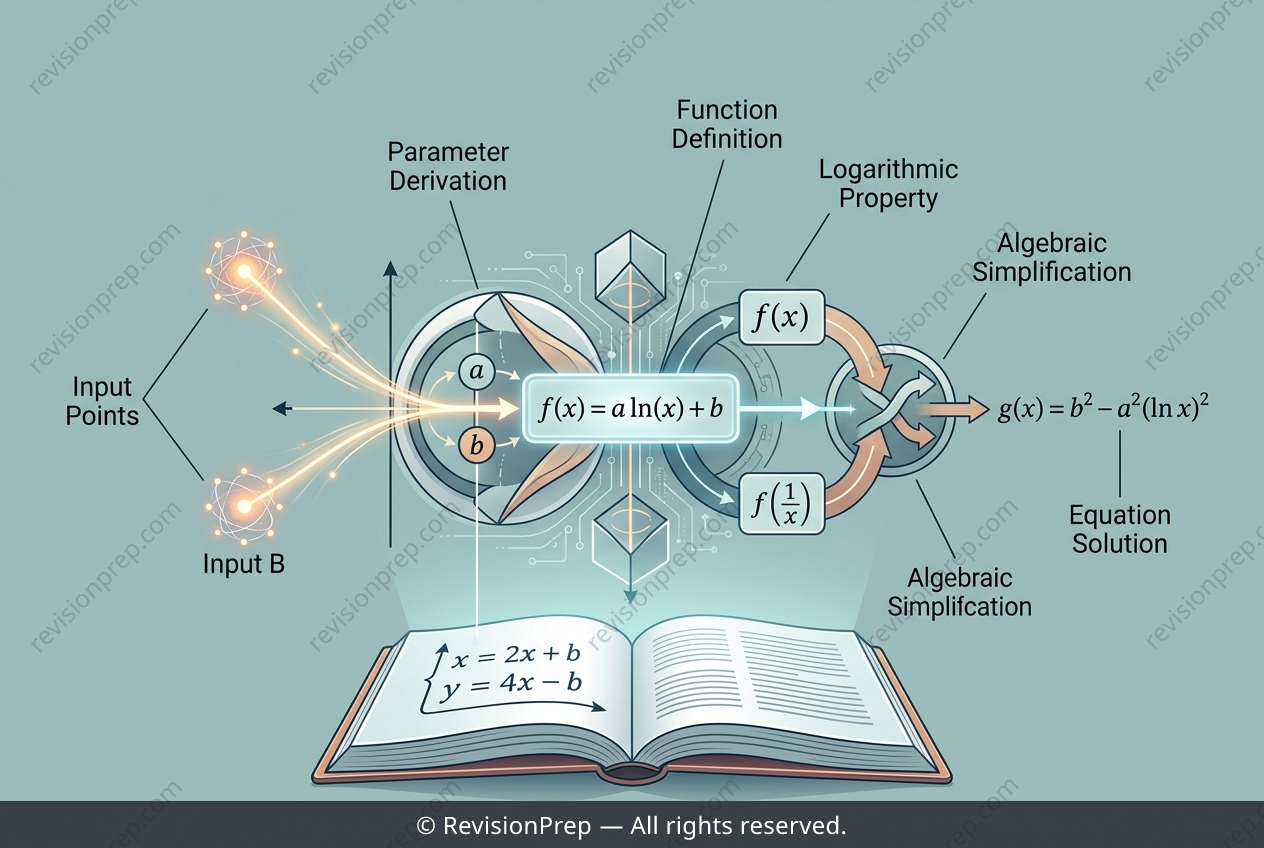
Logarithmic functions of the form f(x) = a ln(x) + b sit at the heart of Number and Algebra, linking two parameters to the shape and position of a curve. Here the constants a and b act as controls: b fixes the vertical intercept, since ln(1) = 0 collapses the term to b, while a governs the steepness and direction of the growth. Reading points off a graph therefore becomes a matter of substitution and solving. The richer idea is how these pieces interact once you manipulate them algebraically. Applying log laws to ln(1/x) turns it into −ln(x), so combining f(x) with f(1/x) produces a difference of two squares, b² − a²(ln x)². This symmetry transforms a product of logarithms into a clean quadratic in ln(x), showing how parameterisation, log rules and algebraic structure connect to reveal where a function equals zero.
Start practising IB questions today
150,000+ IB-styled questions, criteria-mapped and instantly accessible.