
Maths: How Logarithms Reverse an Exponential Decay
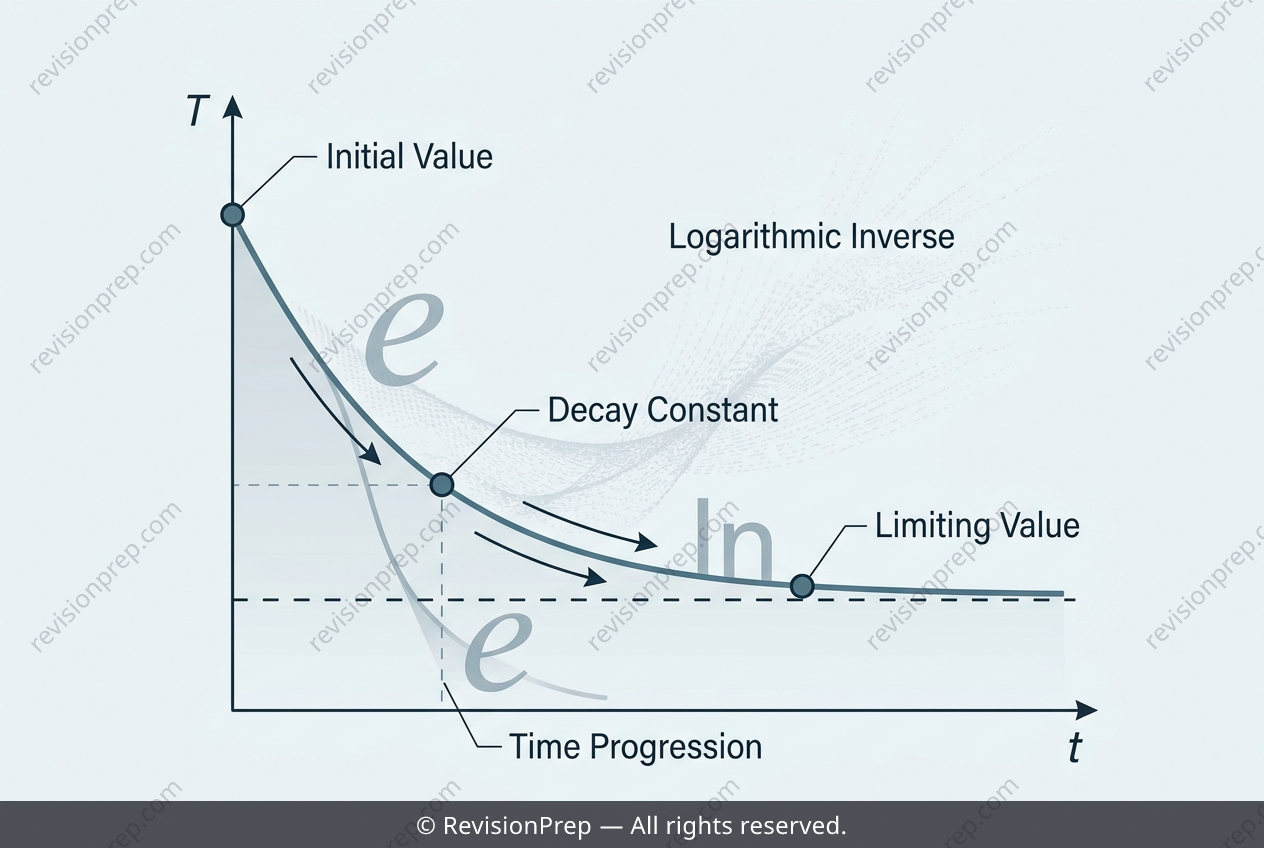
Exponential decay describes how quantities shrink at a rate proportional to their current size, and it underpins models as varied as radioactive half-life, drug clearance, and Newton's law of cooling. The model T = 25 + 75e^(−kt) captures this beautifully: the 25 represents the ambient temperature the rod approaches, while 75e^(−kt) is the excess heat above room temperature that decays over time. The constant k controls how quickly that excess disappears, and finding it is where logarithms earn their keep. Substituting a known temperature at a known time isolates the exponential term, e^(−4k) = 1/3, and taking natural logs of both sides converts that exponential relationship into a linear one, since ln(1/3) = −ln 3. From there, the same technique answers the reverse question: given a target temperature, isolate the exponential, apply logs, and solve for t. The elegance lies in that two-way street — the model predicts temperature at any time, and logarithms recover the time for any temperature.
Start practising IB questions today
150,000+ IB-styled questions, criteria-mapped and instantly accessible.