
Maths: How Logs Reveal the Number of Terms Needed
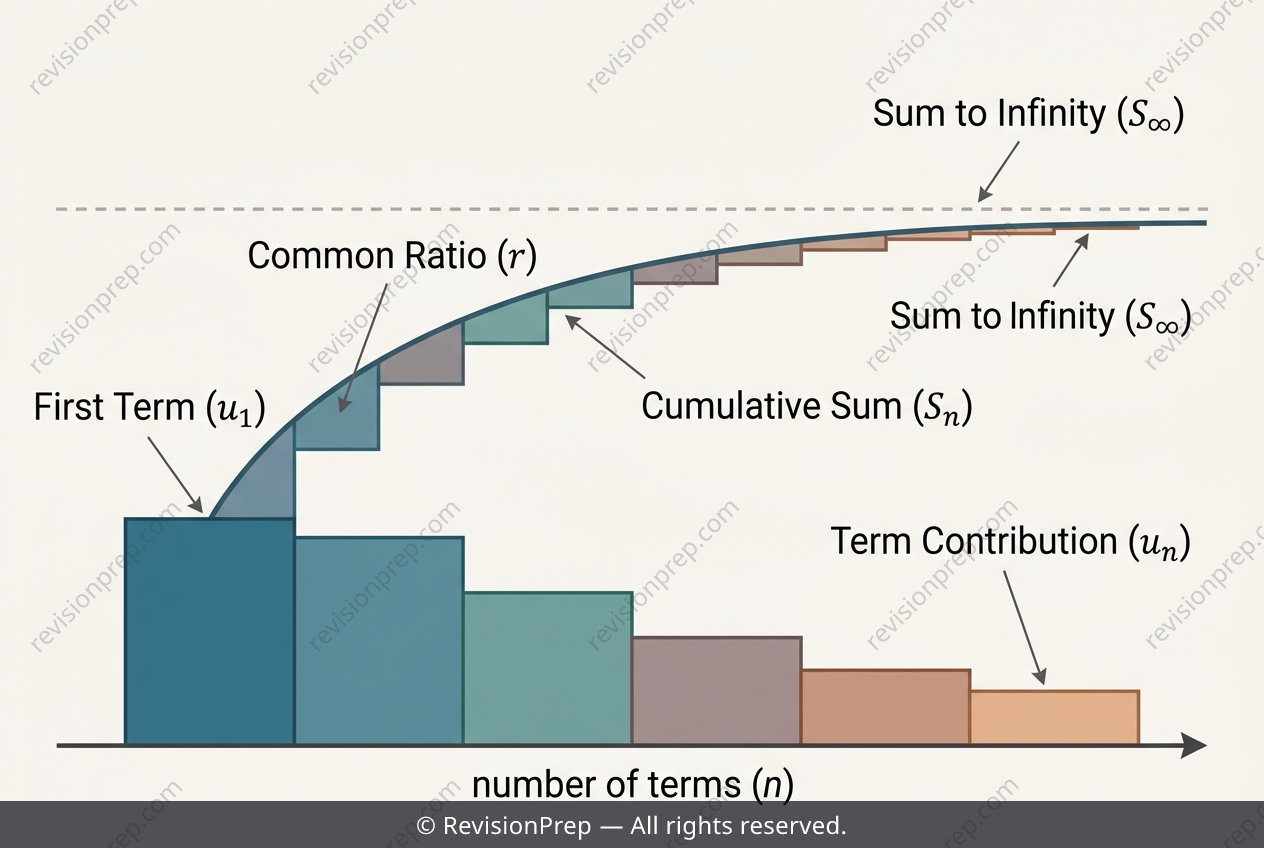
Geometric series sit at the heart of Number and Algebra, describing quantities that grow or shrink by a constant multiplier each step. A geometric sequence has first term u₁ and common ratio r, and its partial sum is captured by Sₙ = u₁(1 − rⁿ)/(1 − r). This compact formula links three ideas: the starting value, the repeated scaling factor, and the number of terms accumulated. Understanding convergence matters because when |r| < 1, each new term shrinks, so the sum creeps toward a finite limit rather than growing without bound. The behaviour hinges on rⁿ: as n increases, (2/3)ⁿ decays toward zero, so Sₙ approaches u₁/(1 − r). Rearranging the sum formula into an inequality, then applying logarithms, reveals how many terms are needed to cross a given threshold — and because ln(2/3) is negative, the inequality direction reverses when dividing.
Start practising IB questions today
150,000+ IB-styled questions, criteria-mapped and instantly accessible.