
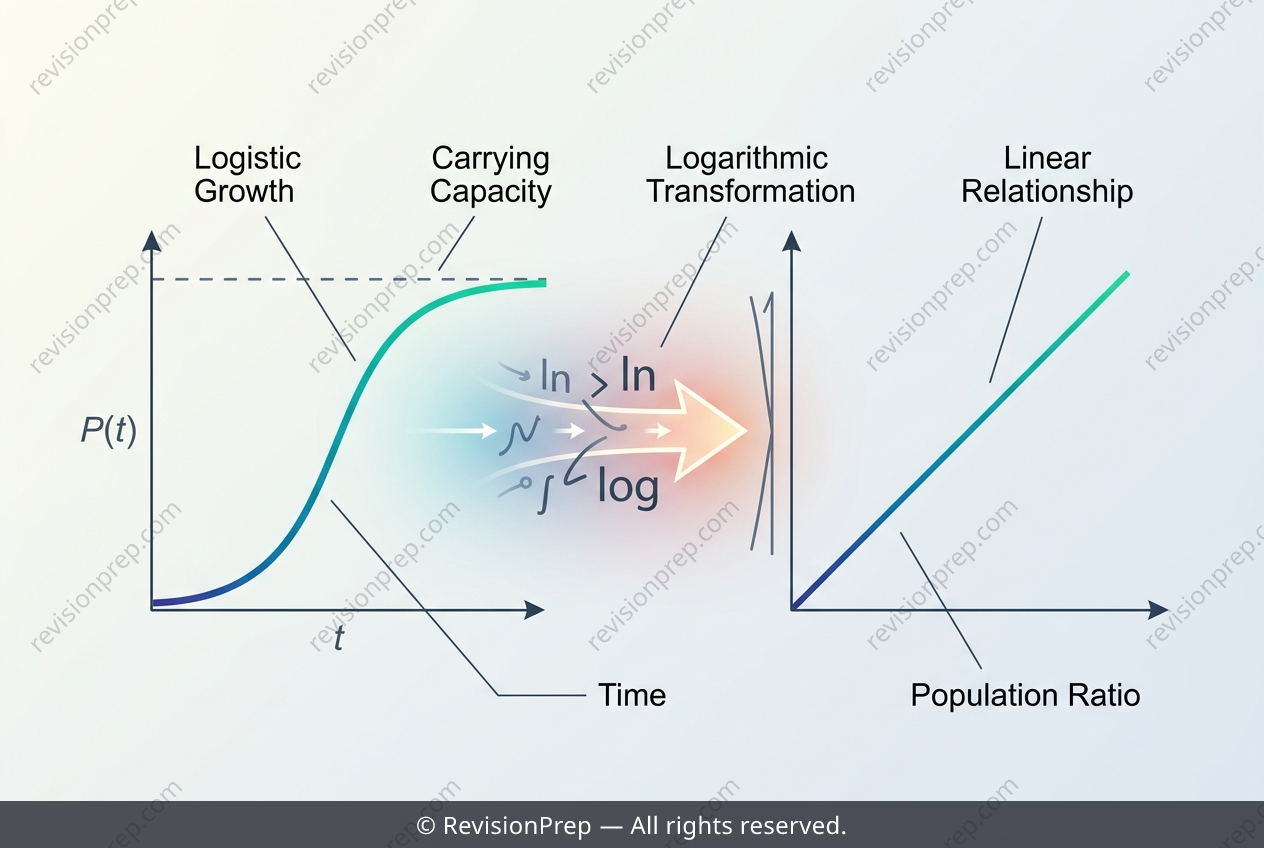
Maths: How Logs Straighten a Logistic Curve
Logistic growth models describe how a population rises quickly at first, then slows as it approaches a natural ceiling. Here, P(t) = 500 / (1 + 4e^(-0.2t)) captures this S-shaped behaviour, where 500 is the carrying capacity and the exponential term controls how fast the curve climbs. Understanding the structure matters because it connects several key ideas. Setting t = 0 reveals the starting population, while rearranging the model isolates the exponential and applies logarithms, turning a curved relationship into a straight line: ln(P / (500 - P)) = 0.2t - ln 4. This transformation is powerful — it linearises the logistic equation, making it far easier to solve for unknown times or populations. The expression P / (500 - P) is especially useful, since it compares the current population to the remaining capacity. From there, substituting a target population and applying log laws leads neatly to an exact time in the form a ln b.
Start practising IB questions today
150,000+ IB-styled questions, criteria-mapped and instantly accessible.