
Maths: How Powers and Logs Unlock Exponential Growth
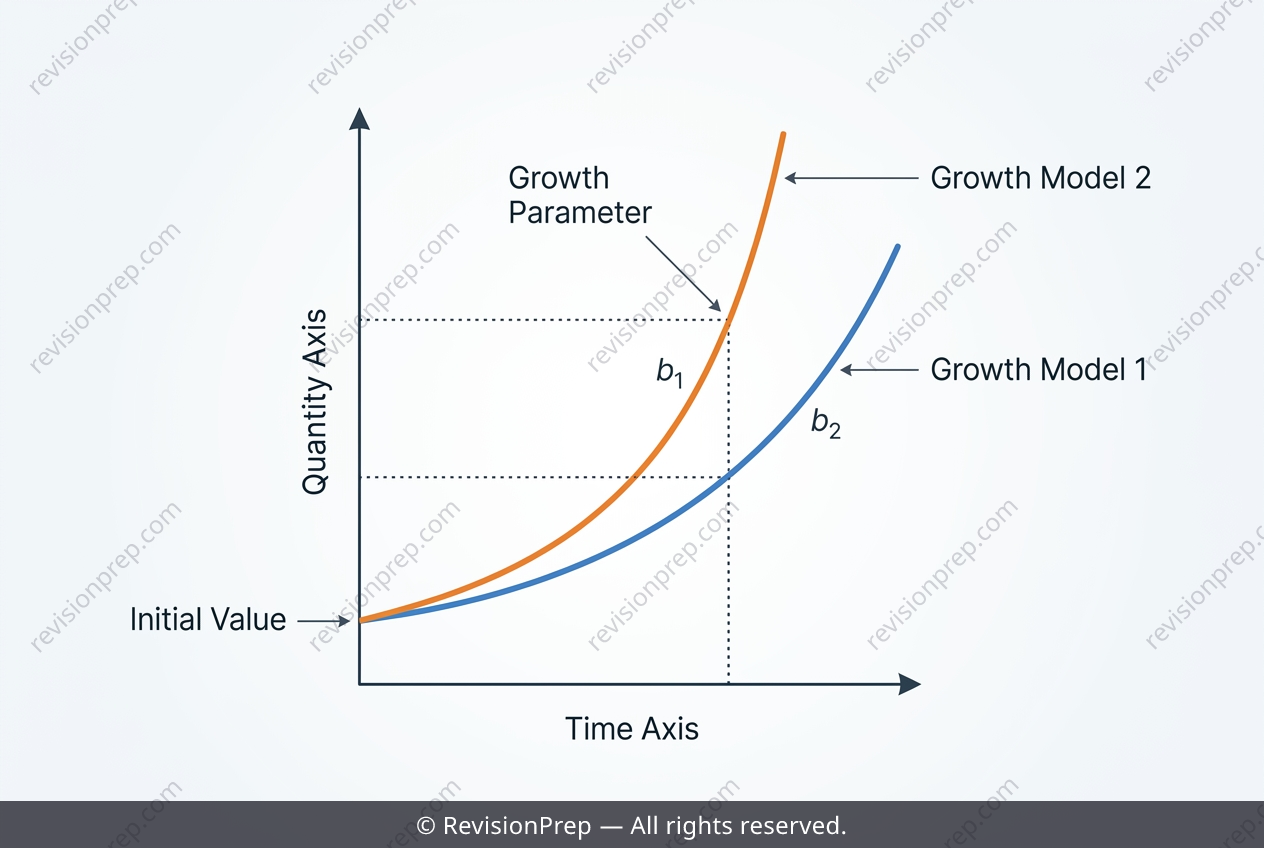
Exponential growth is one of the most powerful ideas in Number and Algebra, describing quantities that multiply by a fixed factor over equal time intervals. In this question, a bacteria culture grows according to N = 500 × 2^(t/12), where the base 2 signals doubling and the exponent t/12 controls how quickly that doubling occurs. Recognising that 4000 is eight times the initial 500, and that 8 = 2³, links the population size directly to the number of doublings, giving t = 36 hours. This matters because the same structure appears throughout science and finance, from radioactive decay to compound interest. The second part shows how doubling relationships simplify comparisons: since 16000 is four times 4000, the culture doubles twice, and each doubling takes twelve hours. The final part swaps the base to 3, so the exponent t/k must be adjusted to preserve the same growth timing, requiring logarithms to solve 3^(36/k) = 8. Together, these ideas connect exponential equations, powers, and logarithms into one coherent modelling toolkit.
Start practising IB questions today
150,000+ IB-styled questions, criteria-mapped and instantly accessible.