
Maths: How Substitution Replaces Polynomial Division
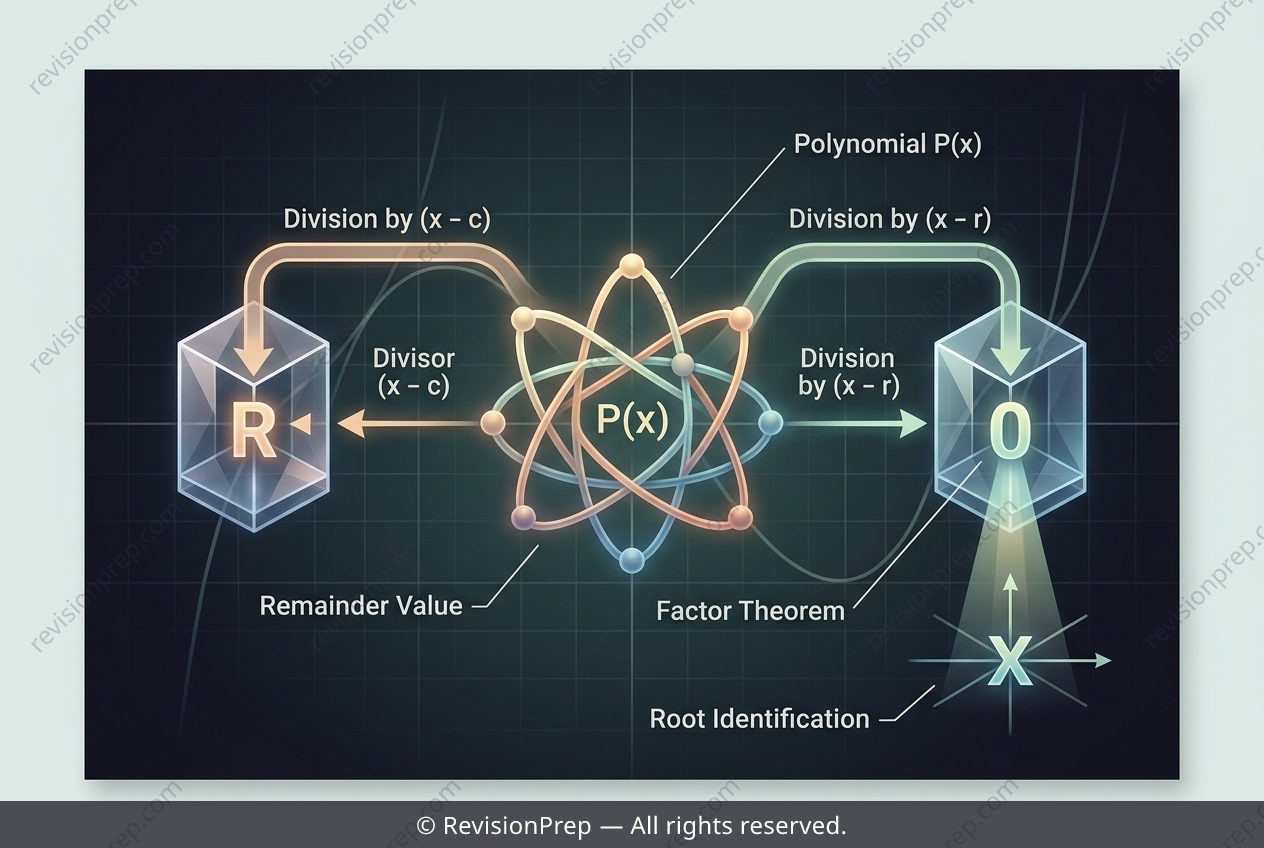
The Remainder and Factor Theorems offer a shortcut for evaluating polynomials without performing long division. The Remainder Theorem states that when a polynomial P(x) is divided by a linear divisor (x − k), the remainder equals P(k). The Factor Theorem extends this: if P(k) = 0, then (x − k) is a factor of P(x), and conversely. These ideas matter because they link division to simple substitution, turning an algebraic process into straightforward arithmetic. In practice, substituting known remainders produces simultaneous equations in the unknown coefficients, which can then be solved. This connection — from division, to substitution, to solving for unknowns — is the heart of the topic. Once the coefficients are known, the same substitution principle finds a remainder for any linear divisor, including ones like (2x − 1), where the value substituted is the root of the divisor.
Start practising IB questions today
150,000+ IB-styled questions, criteria-mapped and instantly accessible.