
Maths: How Systems of Equations Reveal Shape Dimensions
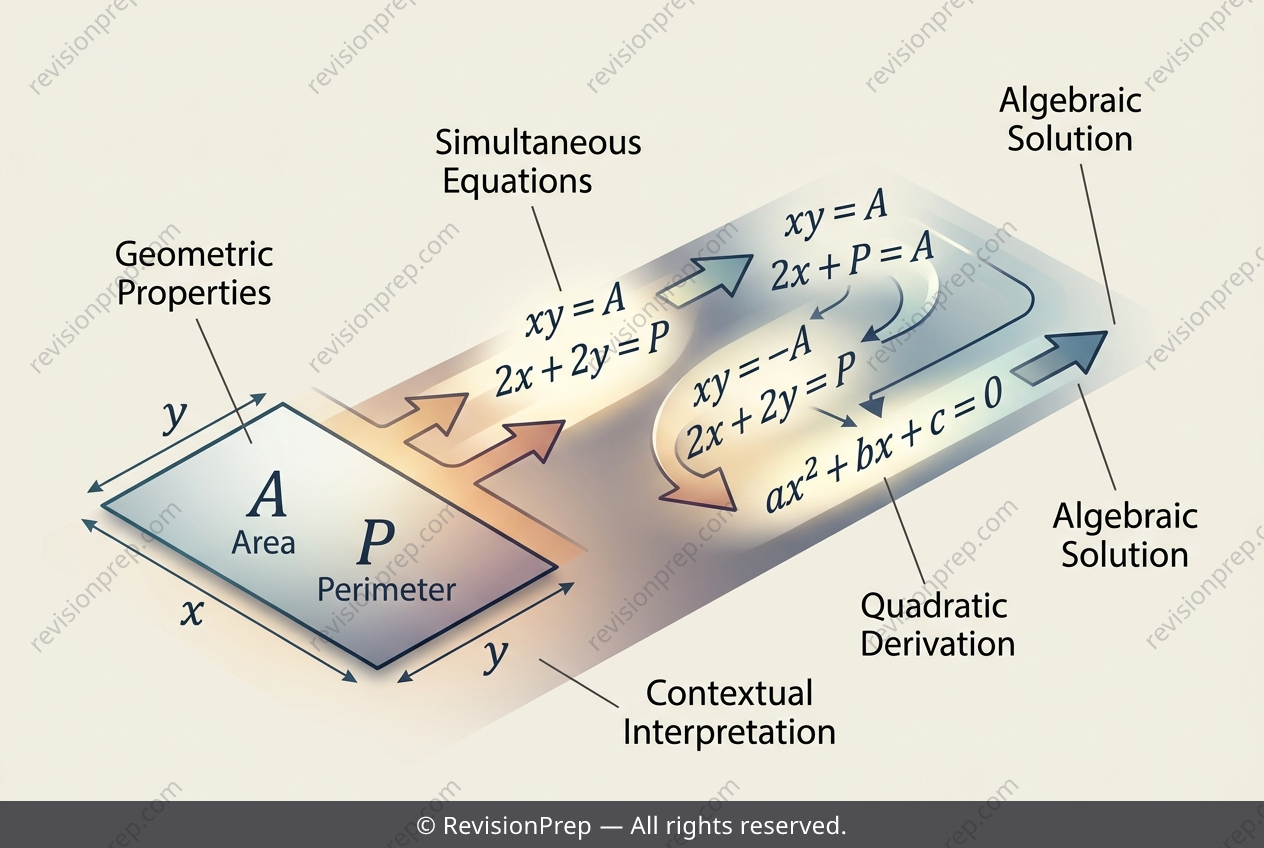
Algebraic modelling of geometric relationships turns the measurements of a shape into equations you can solve. A rectangle's area and perimeter each describe the same pair of unknowns, length and width, in different ways: area gives xy, while perimeter gives 2x + 2y. Together they form a system that pins those unknowns down. This matters because most real modelling problems hand you several facts at once, and the skill lies in translating each fact into its own equation, then combining them into a single relationship. Substituting one equation into another collapses two variables into one quadratic, which factorisation or the quadratic formula can then resolve. Once the dimensions are known, they can be adjusted and compared, for instance by scaling both sides and forming a ratio of new area to old. That final comparison shows how algebraic results feed back into geometric meaning.
Start practising IB questions today
150,000+ IB-styled questions, criteria-mapped and instantly accessible.