
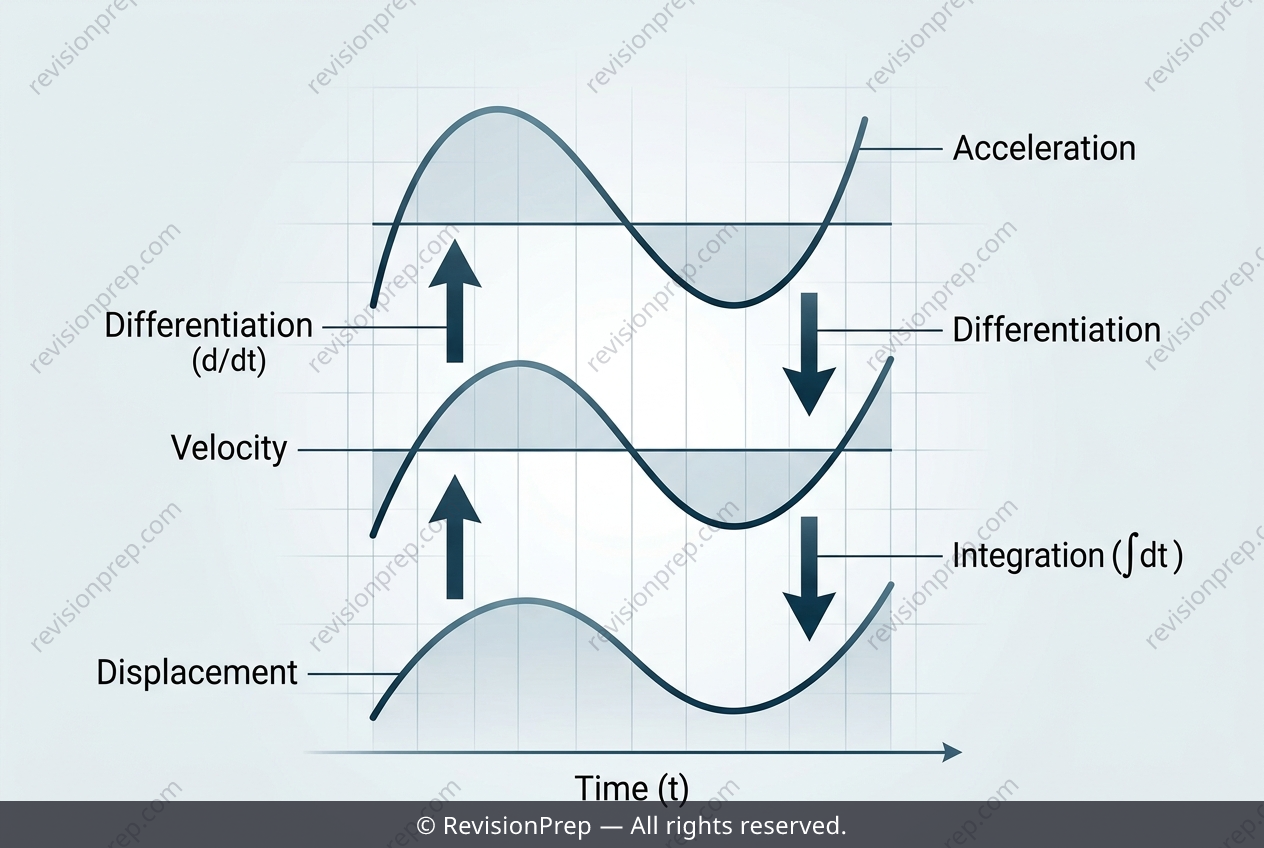
Maths: Kinematics — From Velocity to Displacement
In the study of kinematics, calculus provides the essential language for describing how objects move. The core relationship is beautifully straightforward: velocity is the rate of change of displacement, meaning that displacement is the integral of velocity with respect to time. For a particle moving along a straight line, if you know its velocity function, v(t), you can recover its position, s(t), by integrating. This single idea—that differentiation and integration are inverse operations—turns motion into a solvable problem. This concept matters because it connects the abstract world of derivatives and integrals to a tangible, physical scenario. When you integrate a velocity function like v(t) = 3t² − 4t + 1, you obtain a general expression for displacement, but the constant of integration is unknown. That’s where an initial condition, such as s(0) = 2, becomes crucial: it pins down that constant, giving you the exact position at any time. Furthermore, the moments when a particle is “instantaneously at rest” are found by setting v(t) = 0. Solving that quadratic yields the specific times, and substituting those times back into your displacement expression reveals where the particle is located at those resting instants. Thus, the entire process flows from one fundamental relationship to a complete picture of motion.
Start practising IB questions today
150,000+ IB-styled questions, criteria-mapped and instantly accessible.