
Maths: Median and Probability from One PDF
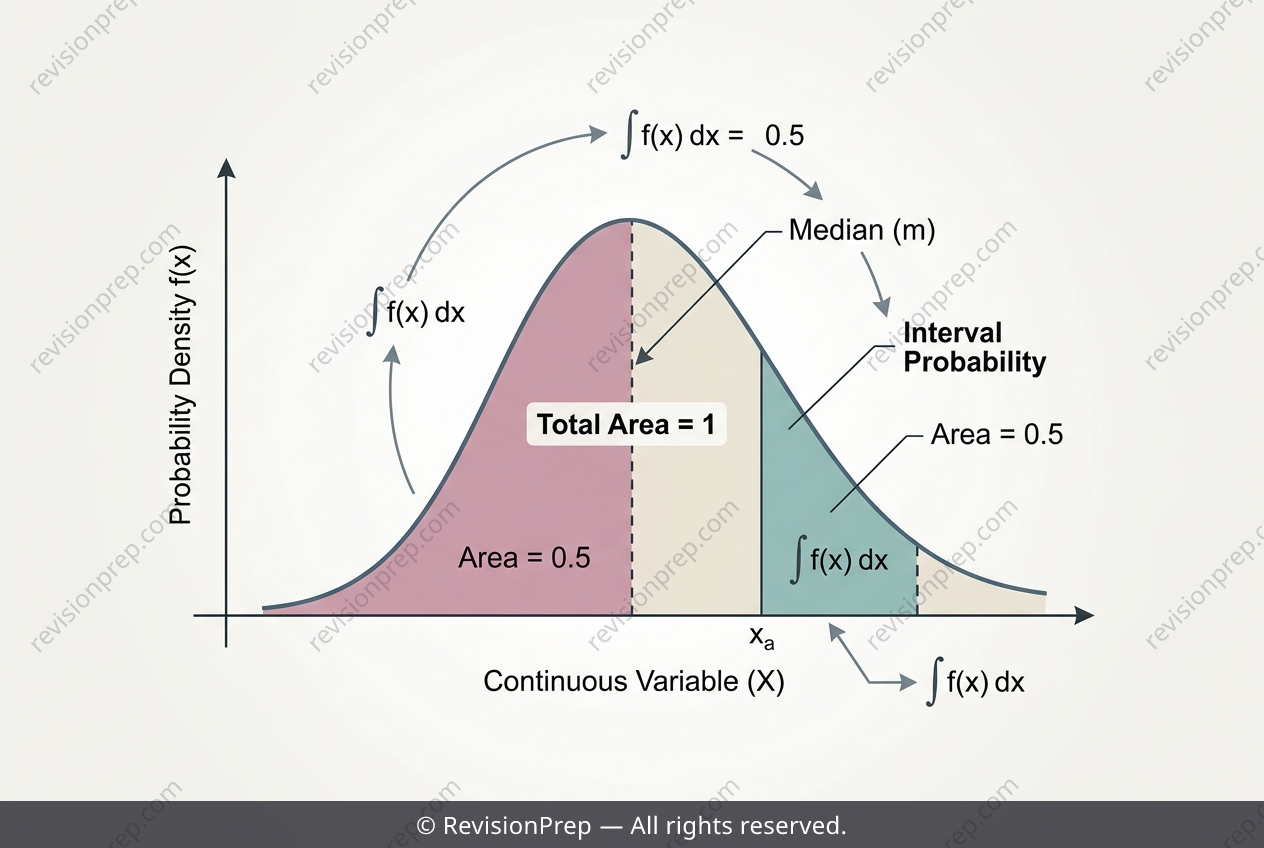
Probability density functions are the mathematical backbone of continuous probability, and this sunflower-height problem is a perfect lens for seeing how they work. At its heart, a PDF like f(h) = (3/4)(h-1)(3-h) on the interval [1, 3] doesn’t give the probability of a specific height—that’s zero for any exact value—but instead describes the relative likelihood of heights across a range. The two non-negotiable rules for any PDF are that it must never dip below zero and that the total area under its curve must equal exactly 1. Here, expanding the quadratic and integrating from 1 to 3 confirms that total area, while checking that both factors stay non-negative within the interval ensures the curve never goes negative. The real power of a PDF emerges when you use it to answer practical questions. The median height, for instance, is found by setting the integral from 1 to m equal to 0.5—splitting the distribution into two equal halves. This leads to a cubic equation that you solve numerically. Meanwhile, the probability of a sunflower being “tall” (exceeding 2.5 m) is simply the area under the curve from 2.5 to 3. These pieces connect: the same antiderivative, once derived, serves both the median calculation and the tail-probability calculation, showing how one continuous model can answer multiple real-world questions about a population.
Start practising IB questions today
150,000+ IB-styled questions, criteria-mapped and instantly accessible.