
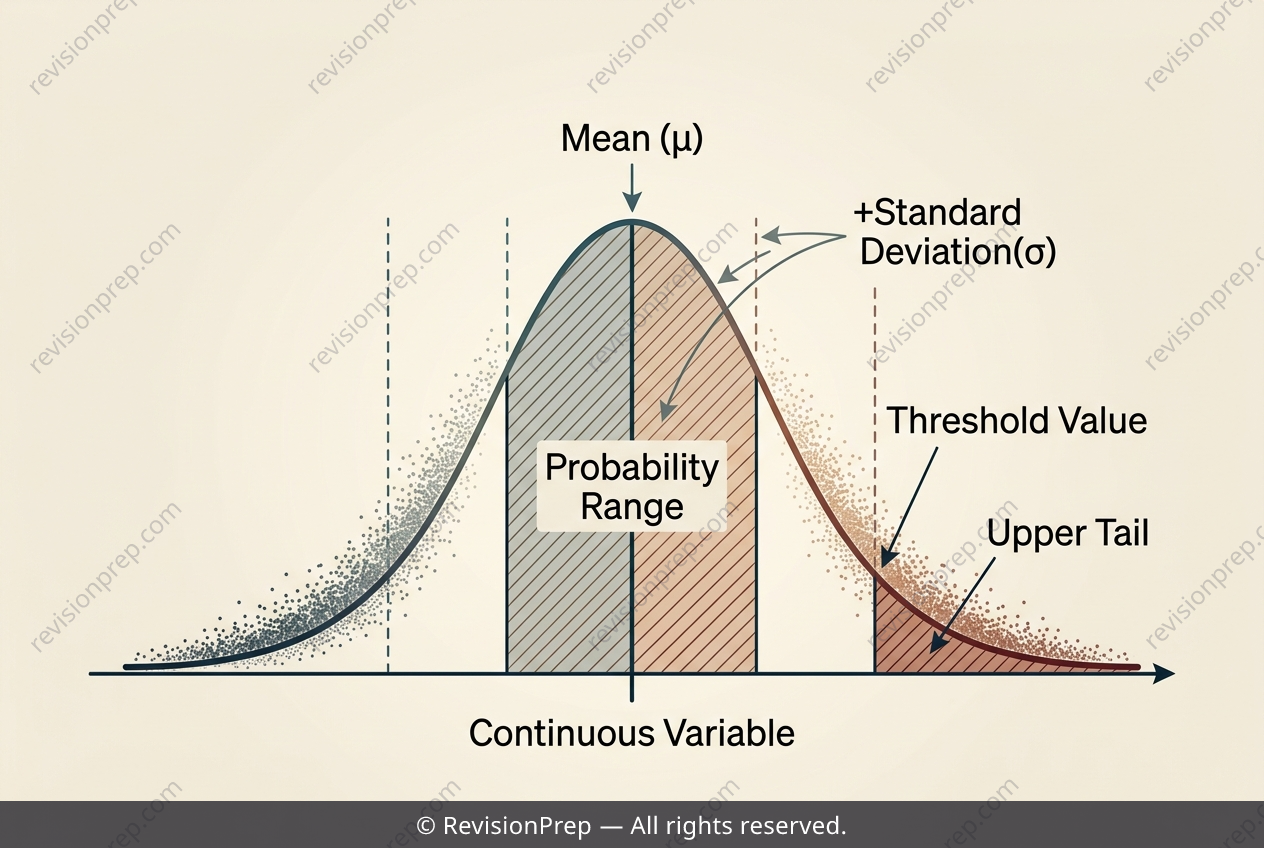
Maths: N(μ, σ²) — Forward and Reverse
The normal distribution is the backbone of statistical inference, and for IB Maths AI SL, it’s the tool you’ll use to model continuous, symmetric data—like the lengths of factory-produced rods. When a variable X is normally distributed with mean μ and standard deviation σ, we write X ~ N(μ, σ²). The key relationship is the z-score, z = (x − μ)/σ, which standardises any value so you can find probabilities using the standard normal curve. This topic matters because real-world quality control, risk assessment, and engineering tolerances all rely on knowing how likely a measurement is to fall within a given range. The beauty of this concept lies in how its parts connect. For part (a), you’re finding the probability between two values, which means calculating the area under the curve between those z-scores—essentially subtracting two cumulative probabilities. For part (b), you reverse the process: given a tail probability (like the longest 3%), you use the inverse normal to find the corresponding z-score, then rearrange the formula to solve for the original length c = μ + z·σ. This two-way thinking—from value to probability and back—is what makes the normal distribution so powerful, and the marking scheme rewards setting up the correct tail and applying the inverse correctly.
Start practising IB questions today
150,000+ IB-styled questions, criteria-mapped and instantly accessible.