
Maths: Rational Functions Link Algebra to Asymptotes
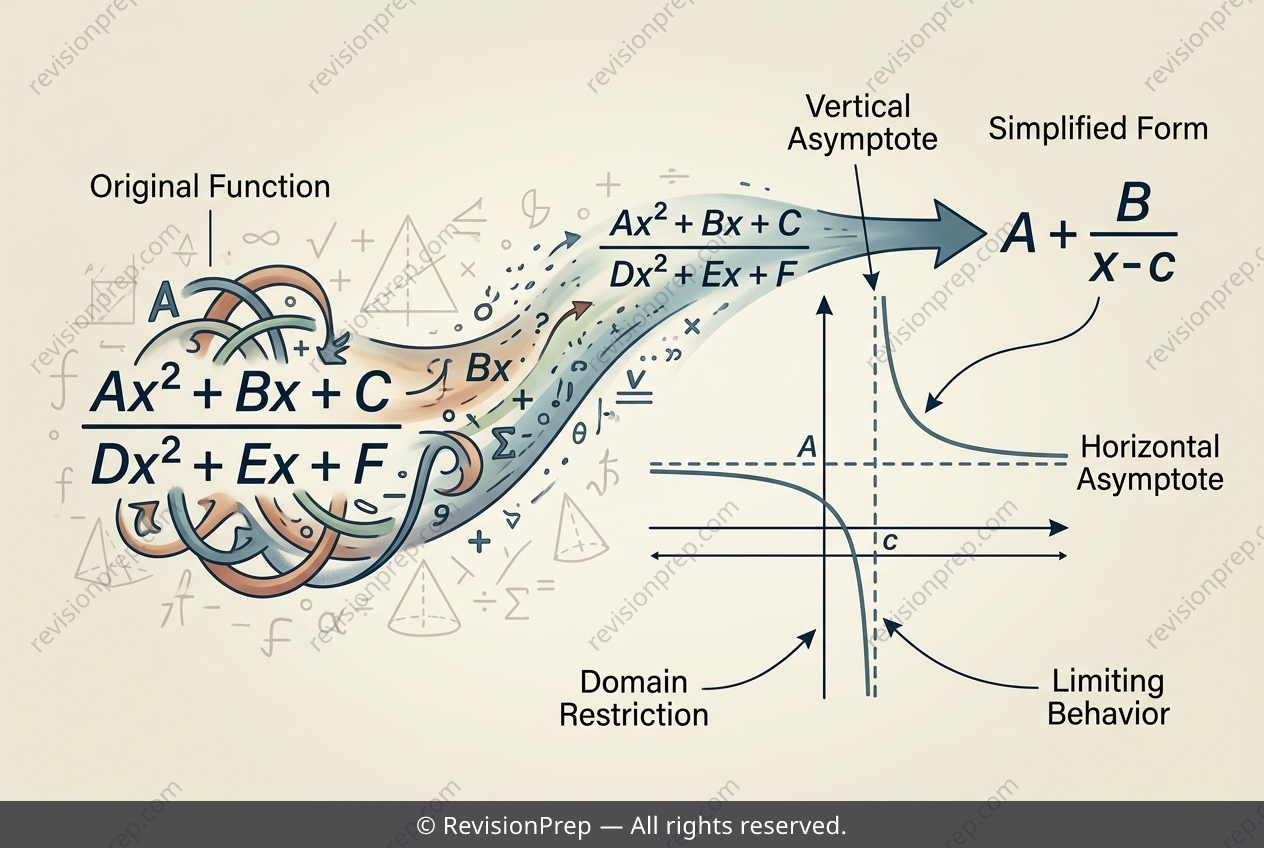
Rational functions often look intimidating, but their behaviour becomes far clearer once you strip them down to essentials. This topic explores how factorising a numerator and denominator can reveal hidden cancellation, turning a complicated-looking expression into a simpler form that exposes its underlying structure. Recognising shared factors like (t − 2) is the key move, since it transforms the function into something you can decompose into a constant plus a remainder term. That decomposition matters because it connects algebra to asymptotic behaviour. Writing a function as A + B/(t − 2) separates the long-run constant value from the part that drives growth or decay, showing how the graph settles toward a horizontal asymptote while a vertical asymptote lurks where the denominator vanishes. Understanding why certain values are excluded from the domain — because they make the expression undefined — ties the algebra back to the real-world model, where time constraints and physical meaning shape which solutions are valid.
Start practising IB questions today
150,000+ IB-styled questions, criteria-mapped and instantly accessible.