
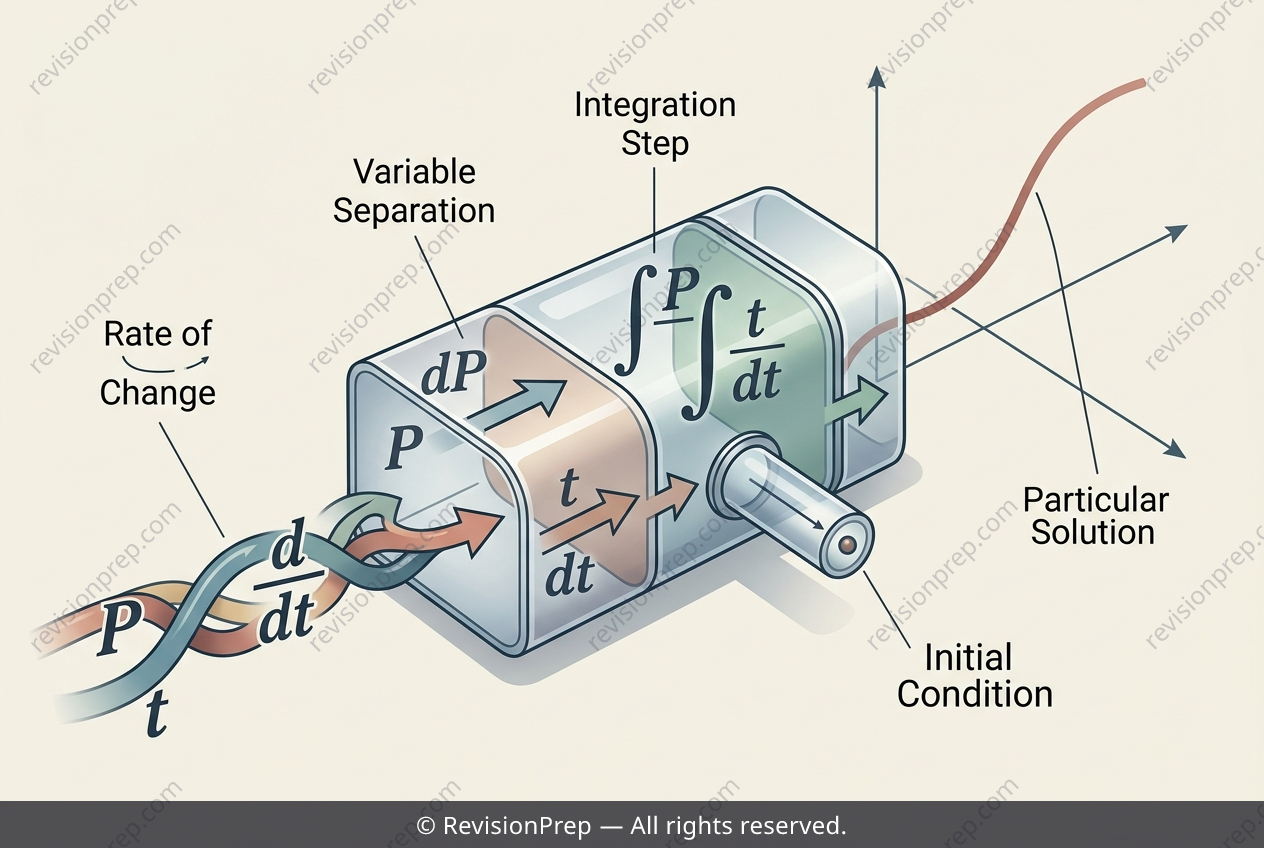
Maths: Solving Differential Equations by Separation
Separable first-order differential equations are the gateway to modelling real-world change—whether it’s population growth, cooling objects, or investment returns—where the rate of change depends on both the current state and time. In this core concept, the key move is to rearrange the equation so that each variable sits on its own side, turning a derivative into two integrable expressions. For a population P (in thousands) growing over time t, the equation dP/dt = 3P/(t+1) shows that the growth rate is proportional to both the existing population and a time-dependent factor. Separating gives 1/P dP = 3/(t+1) dt, which allows us to integrate both sides independently. The left side yields ln P, while the right side yields 3 ln(t+1), and the constant of integration becomes crucial—it is only by exponentiating both sides that the arbitrary constant A emerges, leading to the general form P = A(t+1)³. This structure reveals how the initial condition pins down A, linking the abstract integration to a concrete starting value. Understanding this separation-and-integrate process is essential for tackling any first-order ODE in the IB syllabus, as it transforms a dynamic relationship into a solvable algebraic expression.
Start practising IB questions today
150,000+ IB-styled questions, criteria-mapped and instantly accessible.