
Maths: Solving Logistic Growth with Algebra
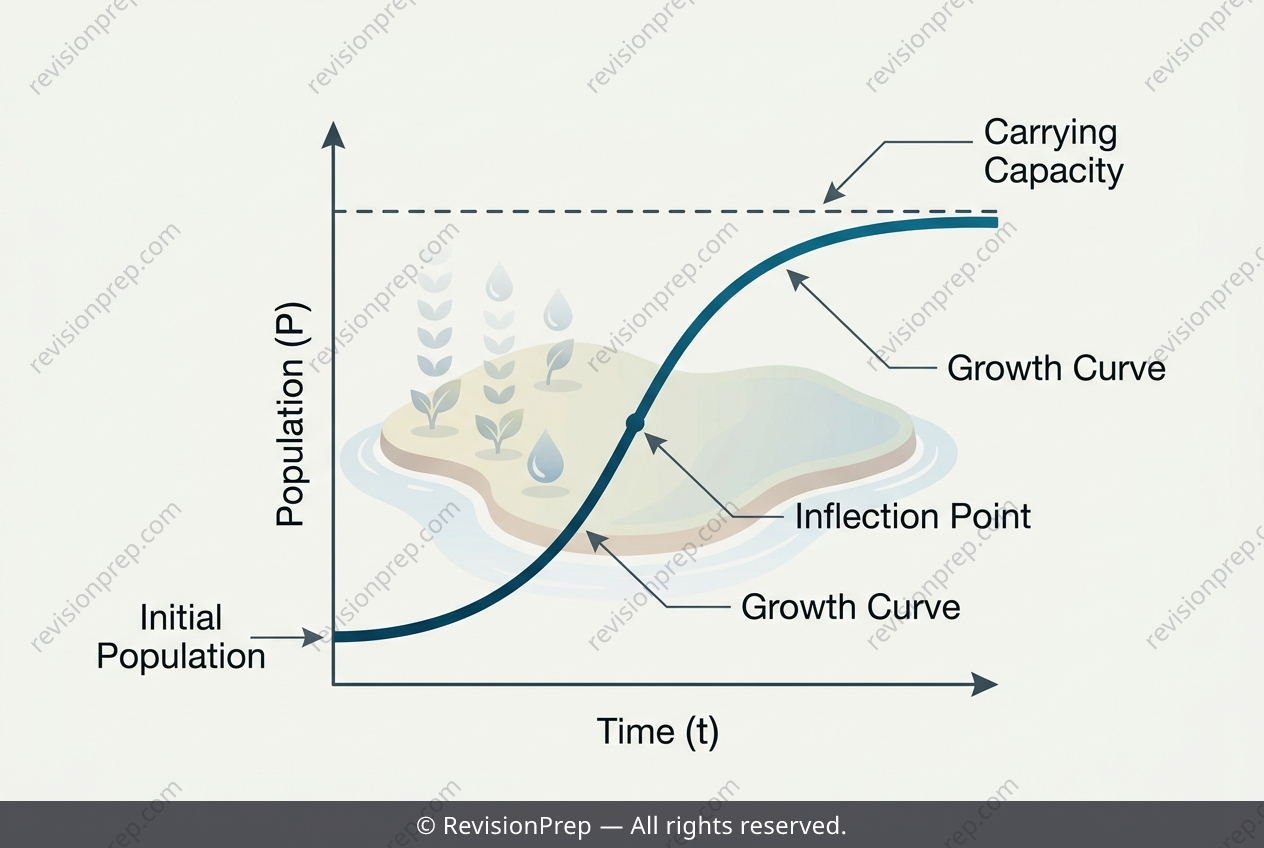
The logistic growth model is a cornerstone of calculus in the IB Maths AA SL syllabus, capturing how a population expands rapidly at first, then slows as it approaches a maximum carrying capacity. In this case, the rabbit colony’s growth is governed by the differential equation dP/dt = P(2000 - P)/4000, where the term (2000 - P) naturally introduces a limiting factor—the island can only sustain so many rabbits. What makes this model elegant is how a clever algebraic identity unlocks the solution. By rewriting 1/P + 1/(2000 - P) as 2000/[P(2000 - P)], the equation becomes separable, allowing you to integrate both sides with ease. This decomposition turns a nonlinear problem into a sum of simpler logarithmic terms, which then rearrange into the classic logistic form P = a/(b + c·e^(-kt)). The constants a, b, c, and k encode the carrying capacity, initial population, and growth rate, respectively. Understanding this connection between algebraic manipulation and differential equations not only solves the problem but reveals the deeper structure behind population dynamics—a skill that extends far beyond rabbits on an island.
Start practising IB questions today
150,000+ IB-styled questions, criteria-mapped and instantly accessible.