
Maths: Solving Volumes of Revolution by Integration
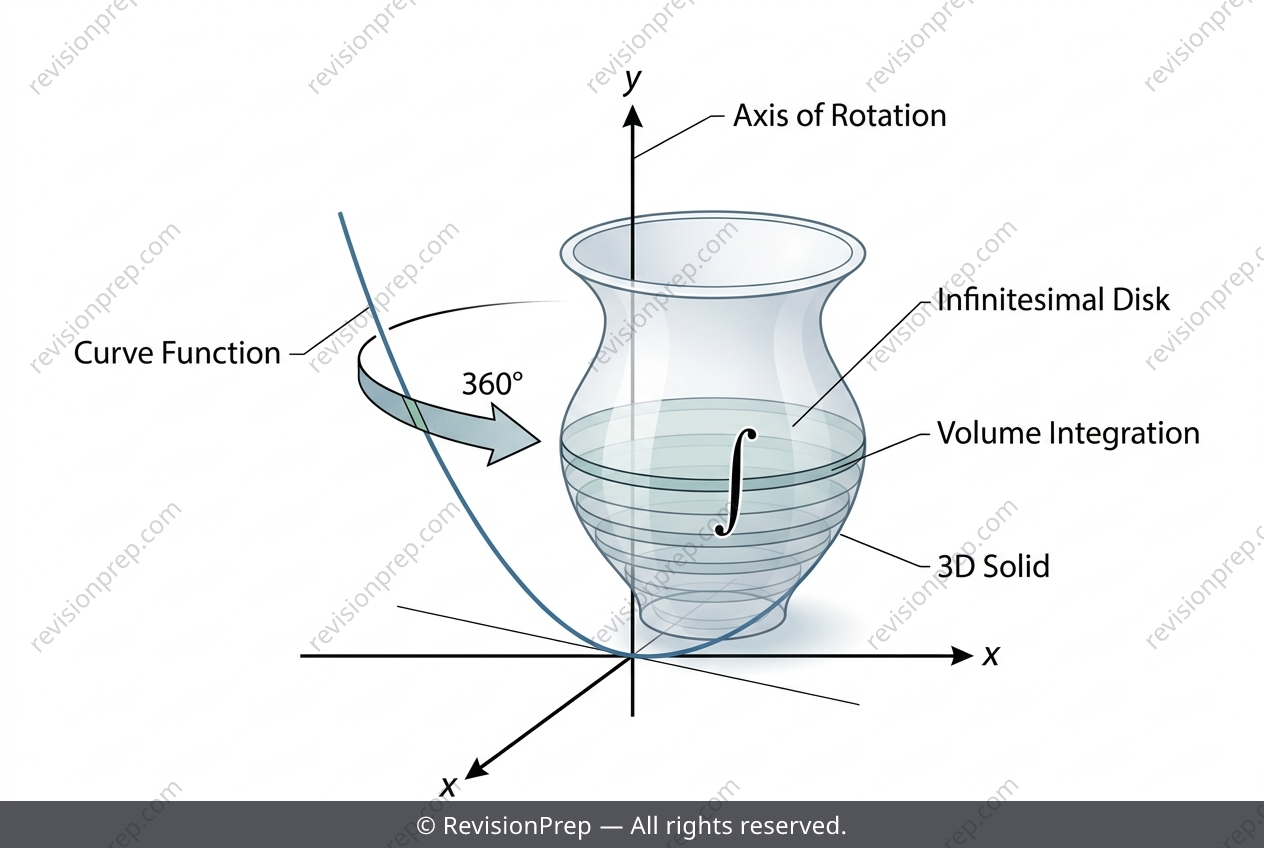
Volumes of revolution are a powerful application of integral calculus, letting you compute the volume of a 3D solid by spinning a 2D curve around an axis. Instead of stacking thin disks or shells physically, you sum infinitely many cross-sectional slices using integration—turning a geometric problem into an algebraic one. Here, the bowl’s shape comes from rotating a parabola about the y-axis, so the formula V = π ∫ x² dy becomes your key tool, where x² expresses the radius of each horizontal slice in terms of its height y. The trick lies in converting between variables. Since the curve is given as y = (1/8)x², you first rearrange to x² = 8y, which directly feeds into the integral. The limits of integration are not the original x-values but the corresponding y-values at the bowl’s base and rim—found by substituting the given x-range. This connection between the axis of rotation and the variable of integration is what makes the method work. Once you set up the integral, evaluating it gives the total volume. For part (b), you then compare that full volume to a water-filling formula, solving for the depth where half the volume is reached—tying the calculus result back to a practical, measurable quantity.
Start practising IB questions today
150,000+ IB-styled questions, criteria-mapped and instantly accessible.