
Maths: Squeeze Theorem and the Limit of sin(x)/x
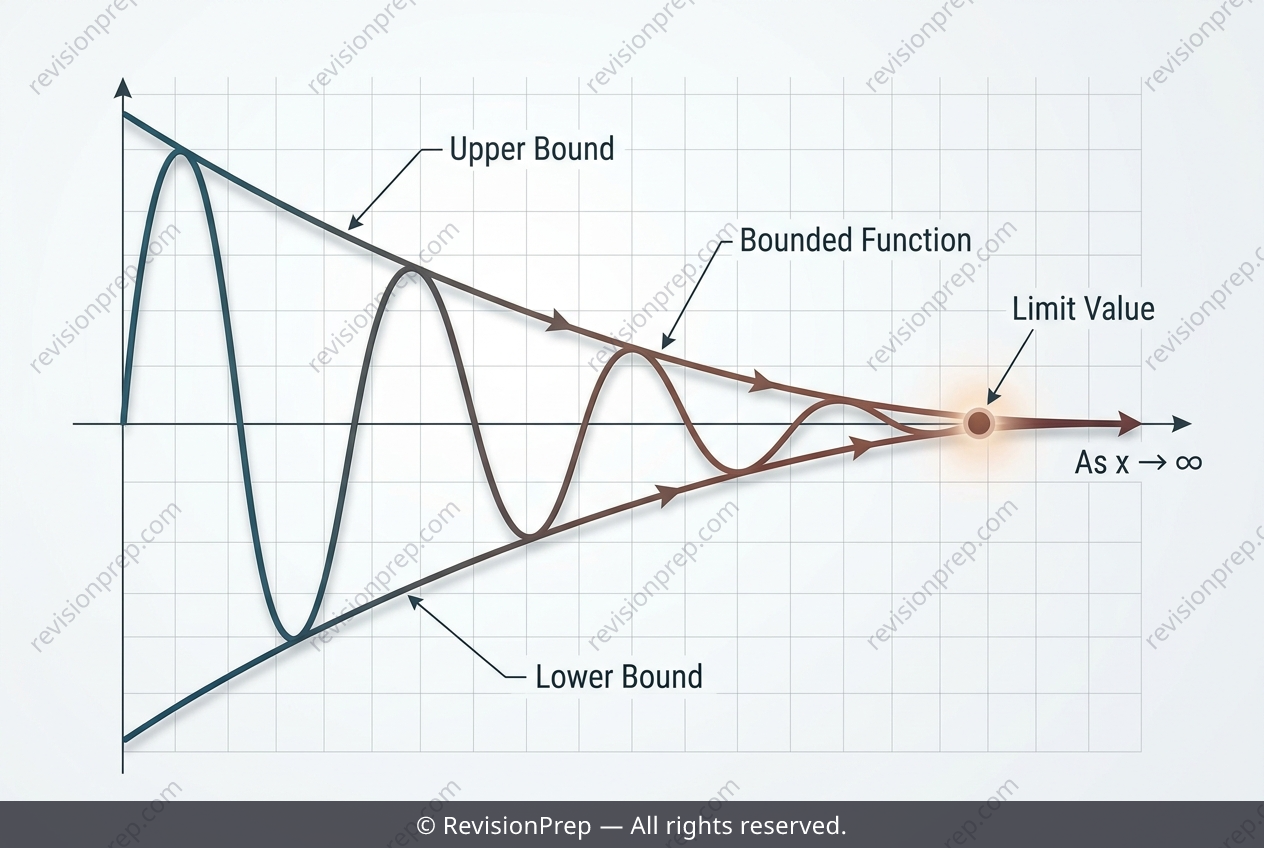
The Squeeze Theorem is one of calculus’s most elegant tools: it lets you pin down a limit you cannot compute directly by trapping the function between two simpler ones whose limits you already know. In this case, the function sin x / x behaves wildly for large x—oscillating forever—yet its overall trend is surprisingly tame. The theorem works because the sine function never escapes the narrow band between -1 and 1, and when you divide that band by x (which grows without bound), the walls of the trap tighten to zero. The key relationship here is that for any positive x, the inequality -1 ≤ sin x ≤ 1 can be divided through by x without flipping the signs, giving -1/x ≤ sin x / x ≤ 1/x. As x heads to infinity, both the lower bound -1/x and the upper bound 1/x squeeze toward 0. Since sin x / x is always caught between them, it must also be pulled to that same limit. This idea—using bounded oscillation plus a shrinking envelope—turns a seemingly impossible limit into a clean, justified result, and it’s a cornerstone for understanding more advanced calculus.
Start practising IB questions today
150,000+ IB-styled questions, criteria-mapped and instantly accessible.