
Maths: Squeeze Theorem and the Limit of √x·cos(1/x)
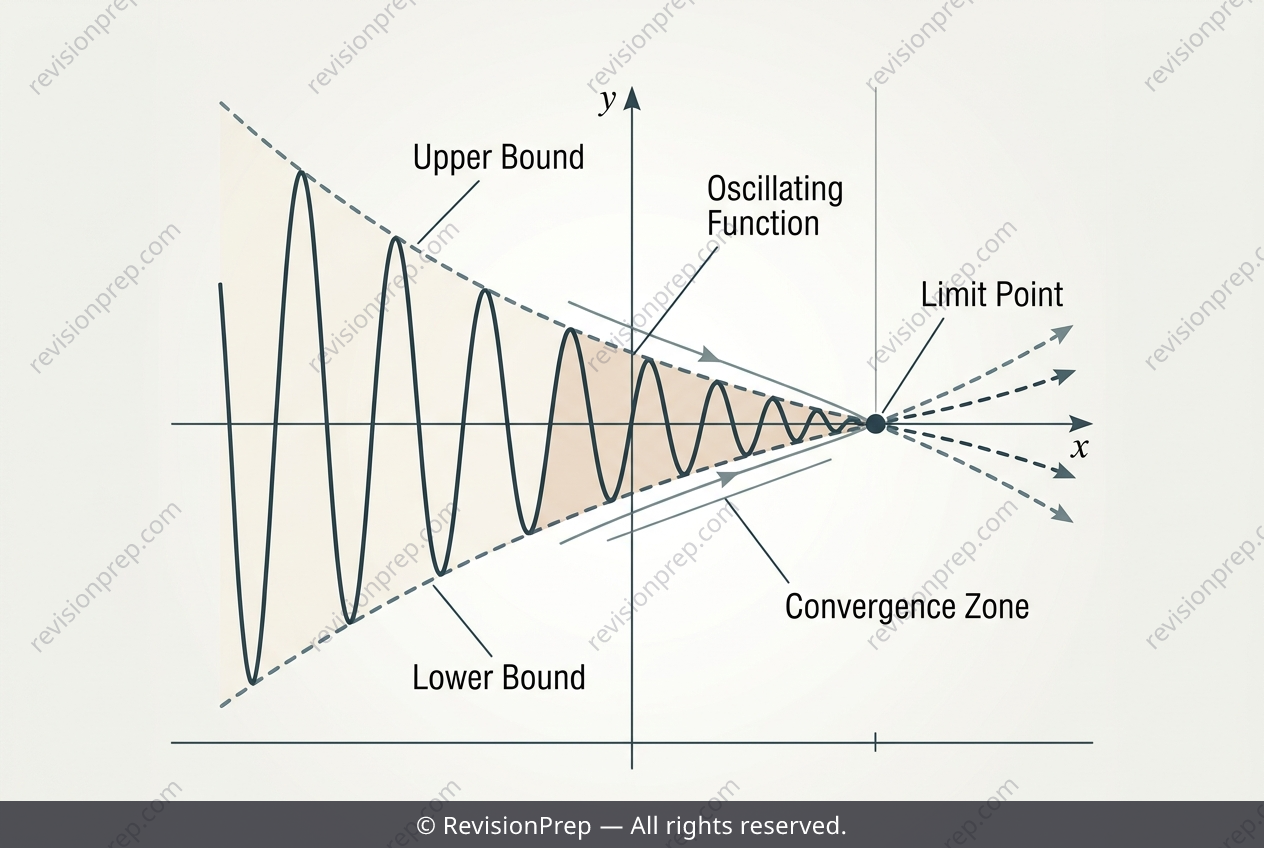
The squeeze theorem is a beautifully simple yet powerful tool for pinning down limits that refuse to be found by direct substitution. At its heart, the idea is this: if you can trap a tricky function between two “simpler” functions that both approach the same value, then the trapped function must approach that same value too. In this case, we meet a function like h(x) = √x · cos(1/x), where the cosine term oscillates wildly as x gets close to zero, making the limit far from obvious. What makes this concept so valuable is how it turns a chaotic-looking problem into a clean inequality argument. The key relationship comes from the fact that cosine is always bounded between -1 and 1. Since √x is positive for x > 0, we can safely multiply this inequality through without flipping the signs, giving us -√x ≤ h(x) ≤ √x. Now, both of these bounding functions—our p(x) and q(x)—smoothly approach zero as x tends to zero from the right. Because h(x) is squeezed between them, the squeeze theorem guarantees its limit must also be zero. This same logic extends even when we consider the absolute value version for both sides of zero, showing how the theorem’s power lies in its reliance on comparison rather than direct calculation.
Start practising IB questions today
150,000+ IB-styled questions, criteria-mapped and instantly accessible.