
Maths: Squeeze Theorem Meets Differentiability
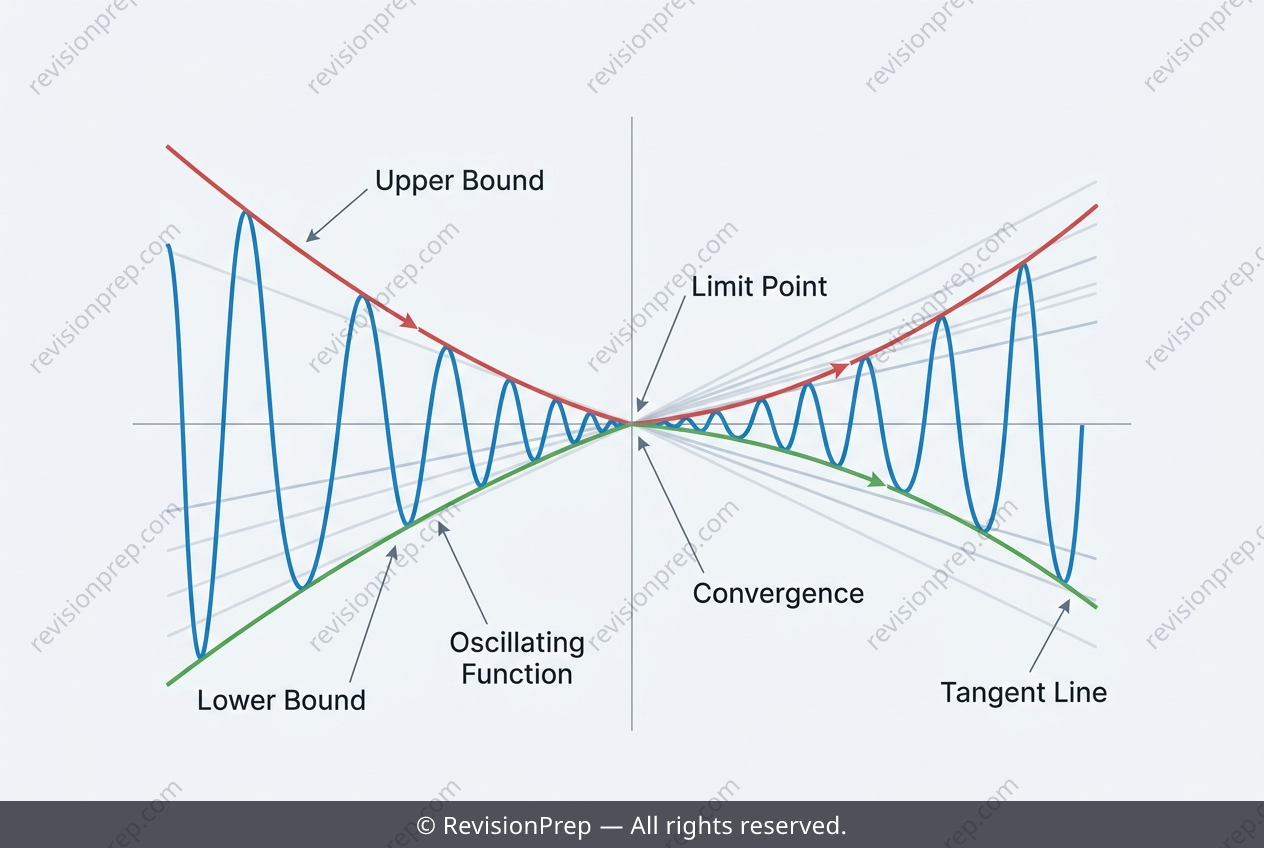
The Squeeze Theorem and differentiability at a point are two cornerstones of calculus that often appear together in IB Maths AA SL. At first glance, they seem separate—one about limits, the other about slopes—but they share a common engine: the careful control of a function’s behaviour near a specific input. The Squeeze Theorem lets us pin down a limit when a function is “trapped” between two simpler functions whose limits are known. Differentiability, meanwhile, asks whether the instantaneous rate of change exists, using the limit definition of the derivative. In the classic example of f(x) = x² sin(1/x) for x ≠ 0 and f(0) = 0, these ideas intertwine beautifully. Because the sine term oscillates wildly near zero, direct substitution fails. However, since sine is always between -1 and 1, multiplying by x² (which is positive for all x ≠ 0) gives the inequality -x² ≤ f(x) ≤ x². This sandwiching is the heart of the Squeeze Theorem: as both outer functions approach 0, the inner one must follow. The same logic then extends to the derivative at x = 0, where the limit of [f(h) - f(0)]/h simplifies to h·sin(1/h), again squeezed between -|h| and |h|. This reveals how bounded oscillation can still yield a smooth, differentiable point—a subtle but powerful relationship.
Start practising IB questions today
150,000+ IB-styled questions, criteria-mapped and instantly accessible.