
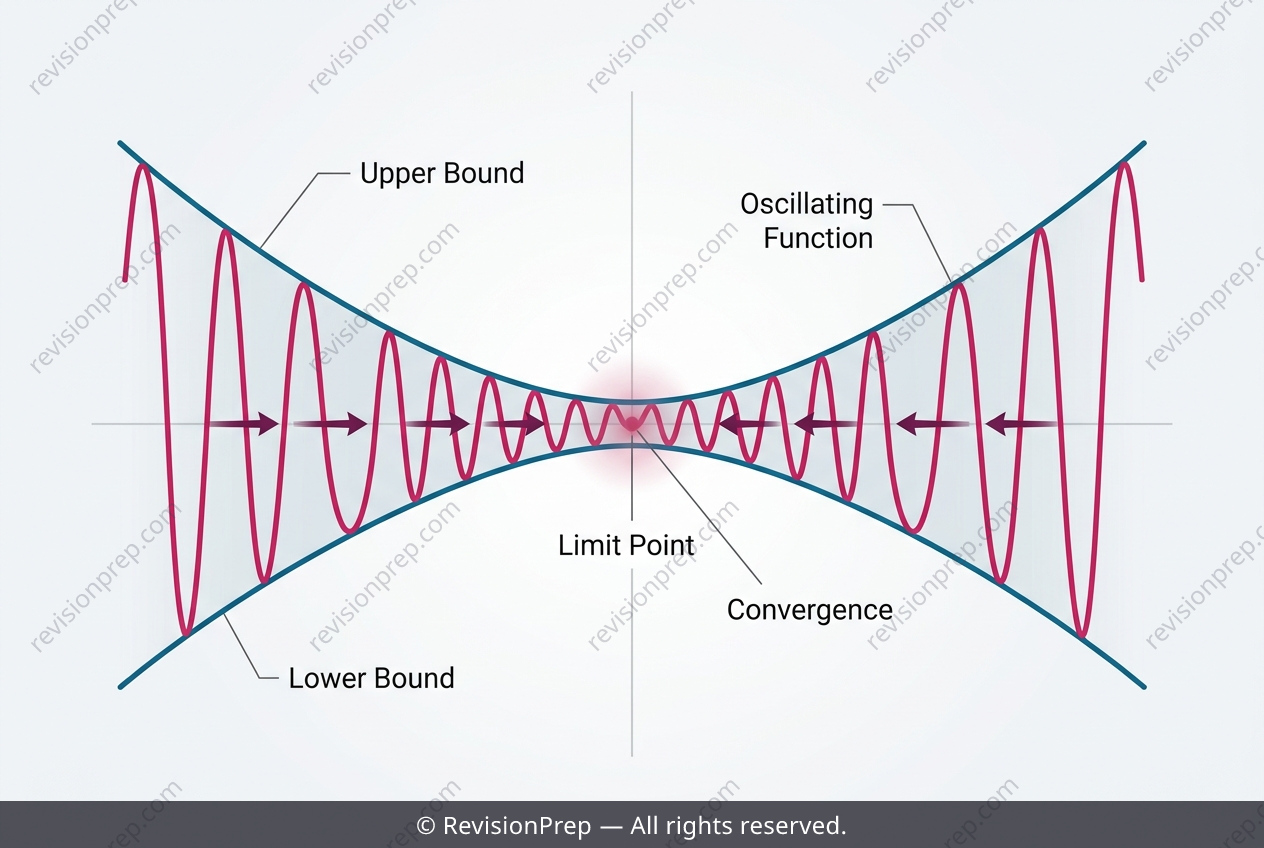
Maths: Squeeze Theorem Proves Differentiability at x=0
Limits and differentiability form the bedrock of calculus, and this classic problem brings them together in a beautifully subtle way. At its heart, the question explores how a function behaves as it approaches a point—here, x = 0—and whether that behaviour allows us to define a tangent line, i.e., a derivative. The function g(x) = x² sin(1/x) for x ≠ 0, with g(0) = 0, is a perfect test case because its oscillating sine term seems chaotic near zero, yet the x² factor tames it. The key mechanism is the Squeeze Theorem. Since sine always lies between -1 and 1, multiplying by x² (which is positive for all x ≠ 0) gives the inequality -x² ≤ g(x) ≤ x². As both bounding functions approach 0 when x tends to 0, the squeeze forces g(x) to also approach 0—this establishes the limit. For differentiability, you apply the definition of the derivative: g'(0) = lim [g(x) - g(0)] / x, which simplifies to lim x sin(1/x). Again, the squeeze theorem applies, this time with bounds -|x| and |x|, both tending to 0. This shows the derivative exists and equals 0, meaning the function is not only continuous but also smooth at that tricky point—a result that feels almost paradoxical given the wild oscillation nearby.
Start practising IB questions today
150,000+ IB-styled questions, criteria-mapped and instantly accessible.