
Maths: Squeeze Theorem Tames x²cos(1/x)
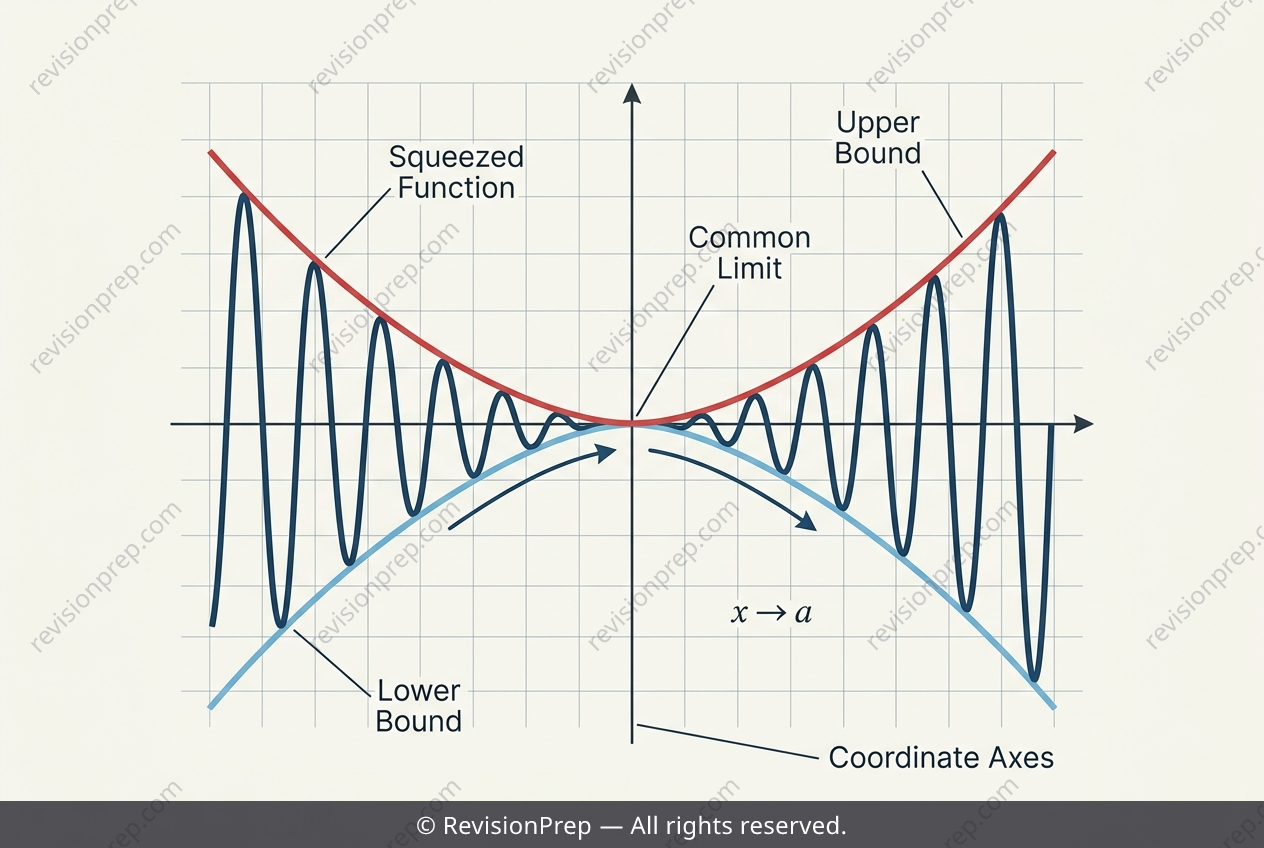
The Squeeze Theorem is a elegant tool for pinning down limits that refuse to be found by direct substitution—especially when a function oscillates wildly near a point. At its heart, the theorem says: if you can trap a tricky function between two simpler ones that both converge to the same value, then the tricky function must converge to that same value too. For the classic example of f(x) = x² cos(1/x) as x approaches 0, the cosine term swings between -1 and 1 infinitely fast, making the limit unclear. But here’s the key: multiplying by x², which is always non-negative, preserves the inequality direction. So you get -x² ≤ x² cos(1/x) ≤ x² for all x ≠ 0. Why does this matter? Because the two bounding functions, -x² and x², both squeeze toward 0 as x → 0. The theorem’s conditions are neatly satisfied: the inequality holds on an interval around 0 (excluding 0 itself), and the limits of both bounds equal 0. That forces the middle function’s limit to also be 0—no matter how wild the cosine behaves. This approach isn’t just a trick; it’s a foundational reasoning pattern for proving limits in calculus, showing how careful bounding can turn chaos into certainty.
Start practising IB questions today
150,000+ IB-styled questions, criteria-mapped and instantly accessible.