
Maths: The Calculus Behind Newton's Law of Cooling
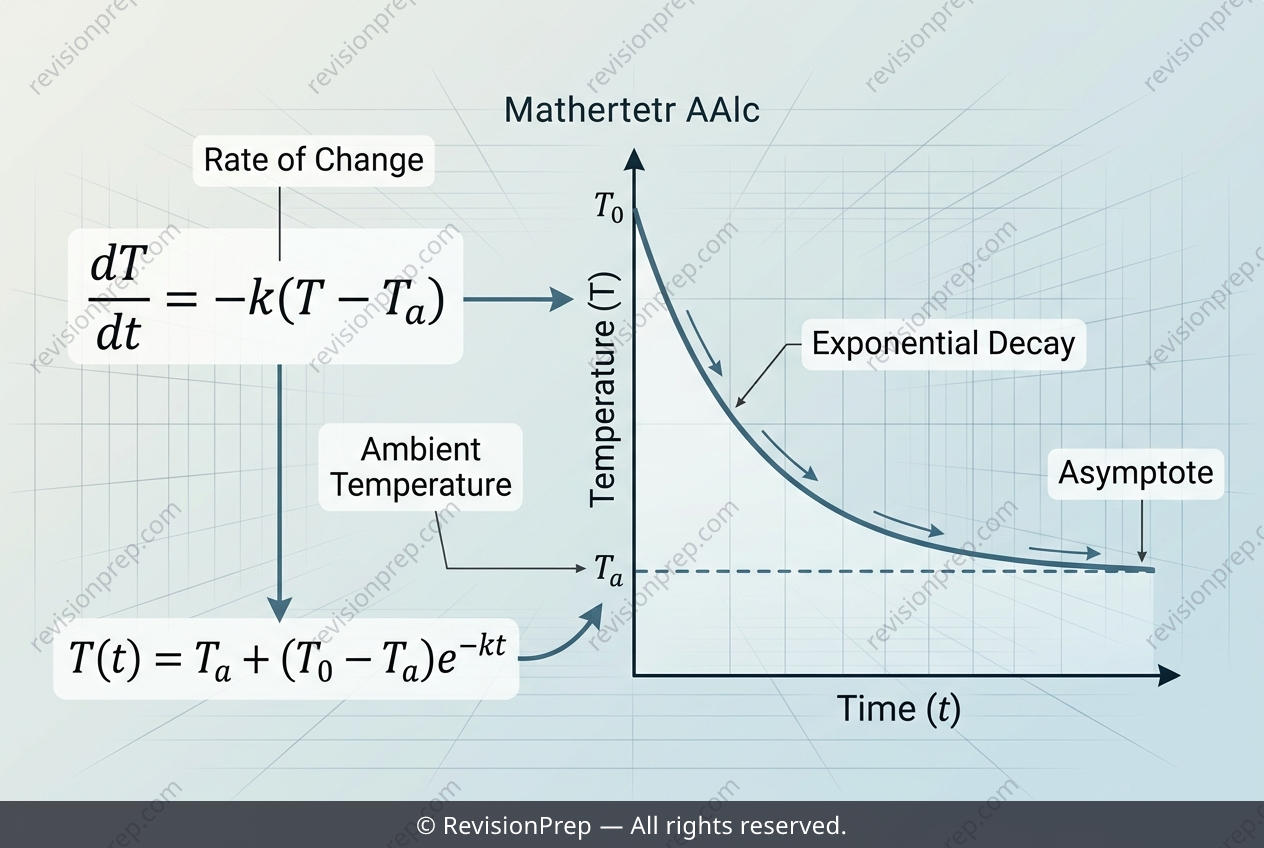
Newton’s Law of Cooling is a classic application of differential equations, and it’s one of the most intuitive ways to see how calculus models real‑world change. At its heart, the law says that the rate at which an object’s temperature changes is proportional to the gap between the object and its surroundings. For a hot cup of coffee in a cooler room, that means the coffee cools fastest when it’s hottest, then slows down as it approaches the ambient temperature. The governing equation, dT/dt = -k(T - 20), captures this with a negative sign (since temperature decreases) and a positive constant k that controls how quickly the cooling happens. What makes this topic powerful is how the differential equation unfolds into a full solution. By separating variables and integrating, you get an exponential function: T = 20 + Ae^(-kt). The constant A is fixed by the initial temperature, while k is determined by a later observation—like the coffee reaching 60°C after five minutes. That single piece of data lets you find the temperature at any future time, because the exponent’s structure means e^(-10k) is simply the square of e^(-5k). This elegant link between rate, initial condition, and exponential decay is why differential equations are essential for modelling everything from cooling drinks to radioactive decay.
Start practising IB questions today
150,000+ IB-styled questions, criteria-mapped and instantly accessible.