
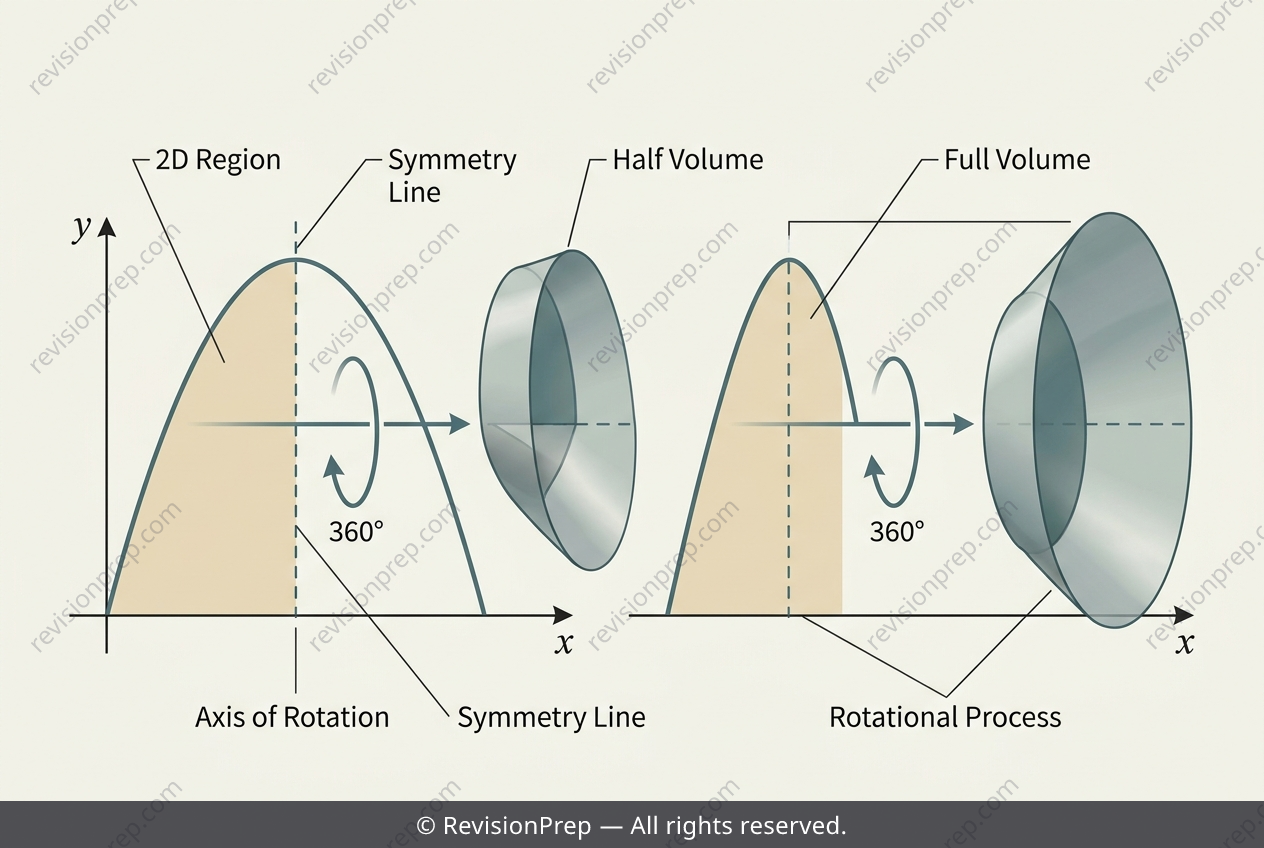
Maths: Using Symmetry to Simplify Volumes of Revolution
Symmetry is one of the most powerful shortcuts in calculus, and nowhere does it shine more clearly than in finding volumes of revolution. When a region under a curve is rotated around an axis, the resulting solid’s volume is given by integrating the square of the function — but that integral can often be halved, doubled, or simplified if the curve has a mirror-like property. In this case, the curve y = sin x on the interval from 0 to π is perfectly symmetric about the line x = π/2, meaning the area under sin²x on the left half is exactly equal to the area on the right half. This symmetry isn’t just a neat observation; it turns a potentially lengthy calculation into a quick, elegant one. The core formula for volume is V = π ∫ sin²x dx, and the trigonometric identity sin²x = (1 − cos 2x)/2 makes the integral straightforward. But the real insight comes in part (b): because the two halves of the interval contribute equally, the volume for the half-region is simply half of the full volume. Understanding this relationship — that symmetry in the function translates directly to symmetry in the integral — allows you to solve problems faster and with greater confidence, while also deepening your intuition for how geometric properties connect to algebraic results.
Start practising IB questions today
150,000+ IB-styled questions, criteria-mapped and instantly accessible.