
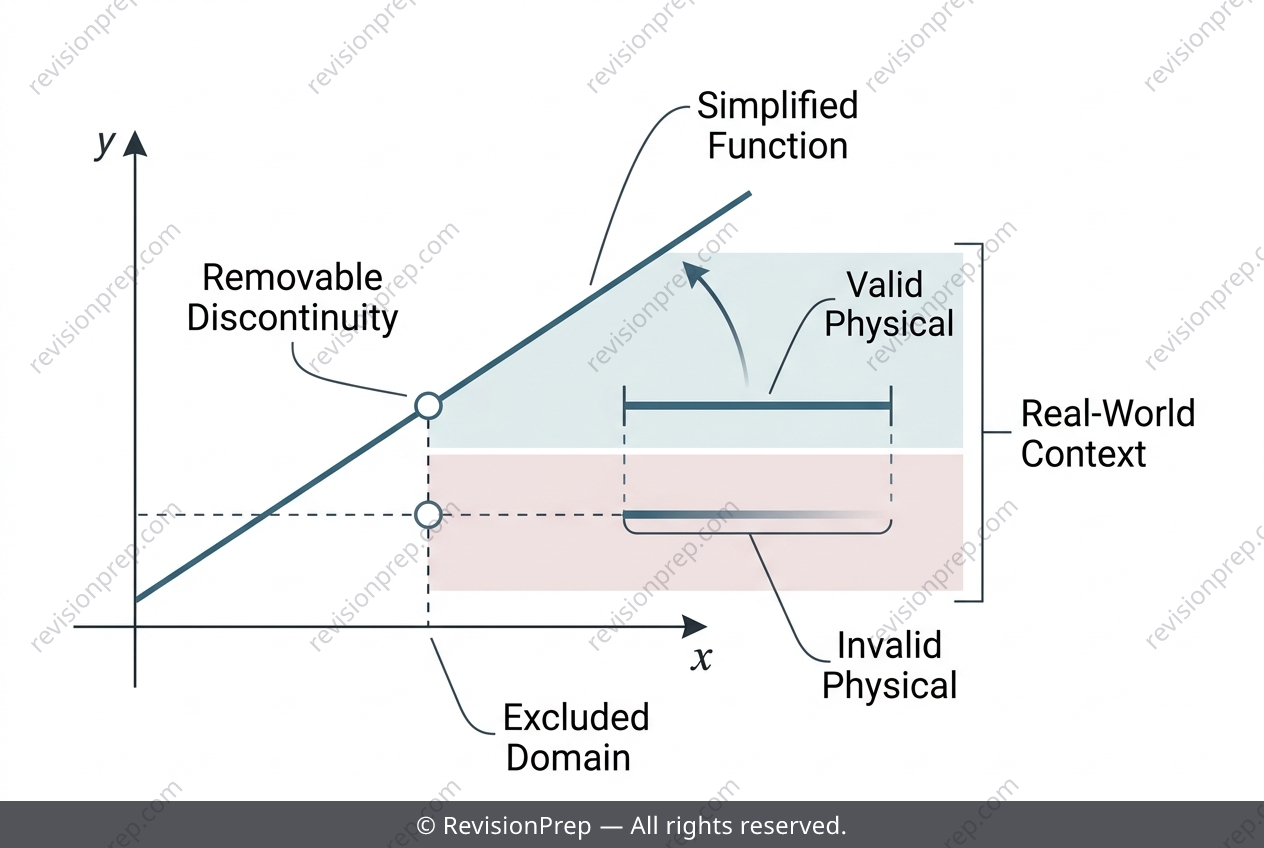
Maths: Why a Cancelled Factor Still Excludes a Value
Rational functions often hide a removable discontinuity — a single point where the expression breaks down even though the graph itself looks perfectly smooth. Factorising the numerator of A(x) = (x² + 2x − 15)/(x − 3) reveals a common factor of (x − 3), which cancels to leave the simpler linear form x + 5. The catch is that the cancelled factor does not vanish from the story: the original denominator still equals zero at x = 3, so that value must be excluded from the domain. This matters because mathematics rarely stays abstract. When a function models a real rectangle, an excluded x-value signals something physically impossible — a side length that cannot exist, leaving the area undefined. Recognising the link between algebraic restrictions and real-world constraints is the heart of this topic. From there, solving an area equation becomes a matter of setting the simplified expression equal to the target value, then checking each solution against the domain restriction to decide which one genuinely holds.
Start practising IB questions today
150,000+ IB-styled questions, criteria-mapped and instantly accessible.