
Maths: Why the Larger Exponent Wins Over Time
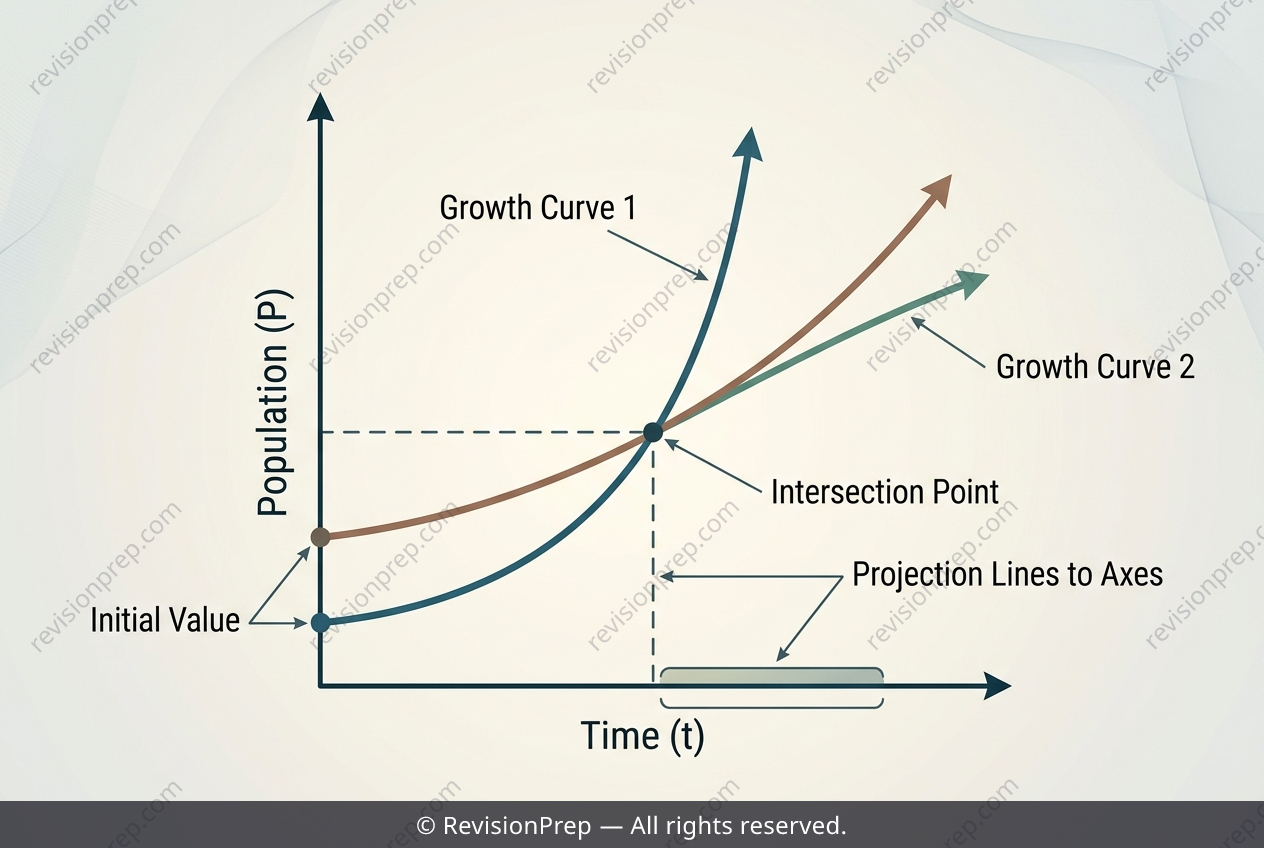
Exponential models describe quantities that multiply by a fixed factor over equal time intervals, and they appear everywhere from bacterial cultures to compound interest. In this question, a colony starts with 500 bacteria and grows according to P(t) = 500 × 2^(0.2t), where the base 2 signals doubling and the exponent 0.2t controls how quickly that doubling unfolds. Understanding the structure matters more than memorising steps. Substituting a time value gives the population at that moment, while setting P(t) equal to a target and rewriting both sides as powers of 2 turns an exponential equation into a simple linear one. Comparing two cultures means equating their models and dividing through to isolate the ratio of growth factors, since the starting values differ but the exponents govern long-term behaviour. Whichever model carries the larger exponent eventually dominates, so the faster-growing culture overtakes the slower one and stays ahead.
Start practising IB questions today
150,000+ IB-styled questions, criteria-mapped and instantly accessible.