
Physics: Decoding Wavelength and Amplitude in Waves
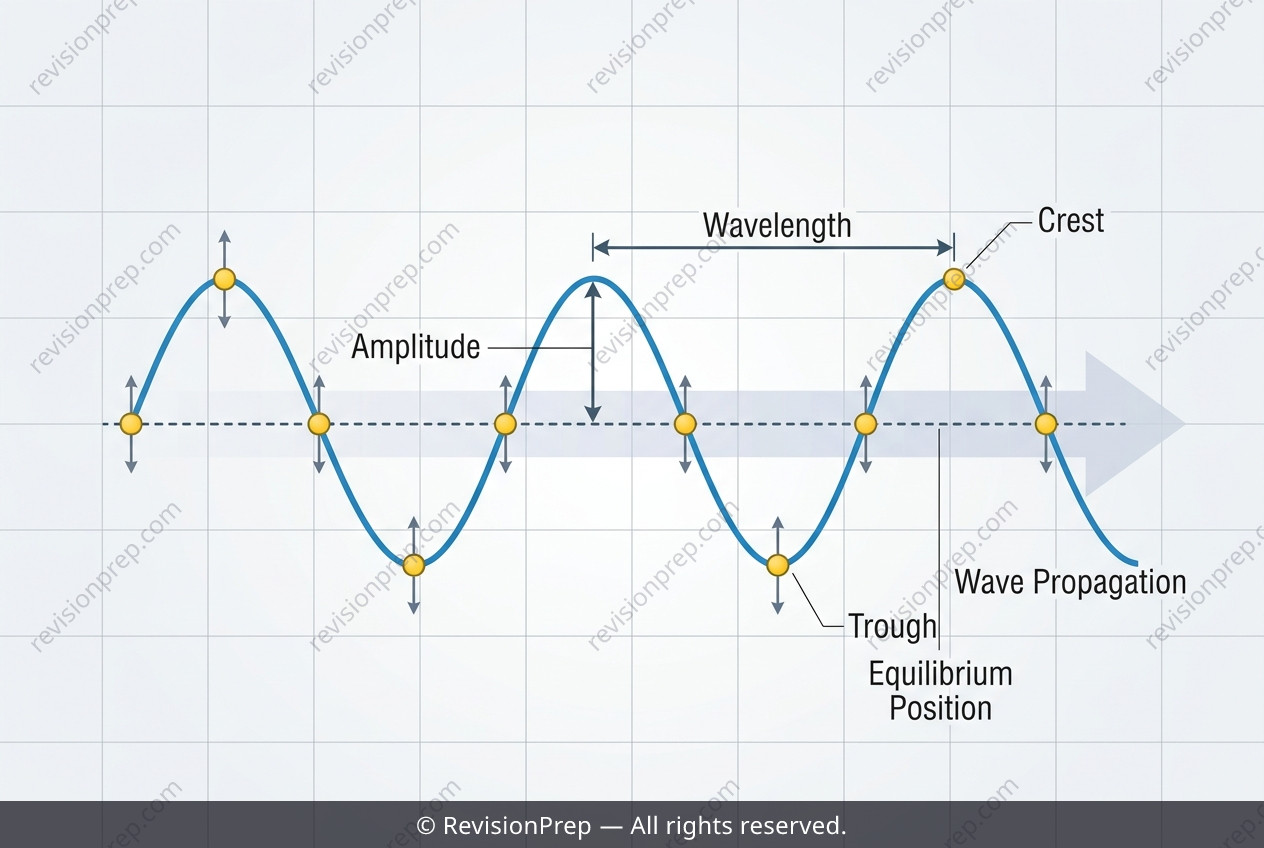
In the study of wave behaviour, few ideas are as foundational as the language used to describe a wave’s shape and size. At its heart, a transverse wave is a disturbance that carries energy through a medium, with particles moving perpendicular to the direction of energy transfer. When we freeze that motion in time—as in a snapshot graph—we see a repeating pattern of crests and troughs. Two key measurements emerge from this picture: the wavelength, which is the distance between two consecutive identical points (like crest to crest), and the amplitude, which captures how far the wave’s displacement reaches from its undisturbed, or equilibrium, position. Understanding amplitude is crucial because it directly relates to the energy a wave transports: greater amplitude means greater energy. In a snapshot graph, the amplitude is not the distance between a crest and a trough, nor is it the full vertical span of the wave. Instead, it is the single, maximum displacement from the equilibrium line—measured from the middle of the wave to the top of a crest (or bottom of a trough). This distinction is easy to miss when a graph shows both crests and troughs, but the definition remains constant: amplitude is always that one-sided, maximum departure from rest. By separating the concepts of wavelength (spatial periodicity) and amplitude (energy-carrying height), you build a precise mental model for analysing any wave diagram.
Start practising IB questions today
150,000+ IB-styled questions, criteria-mapped and instantly accessible.