
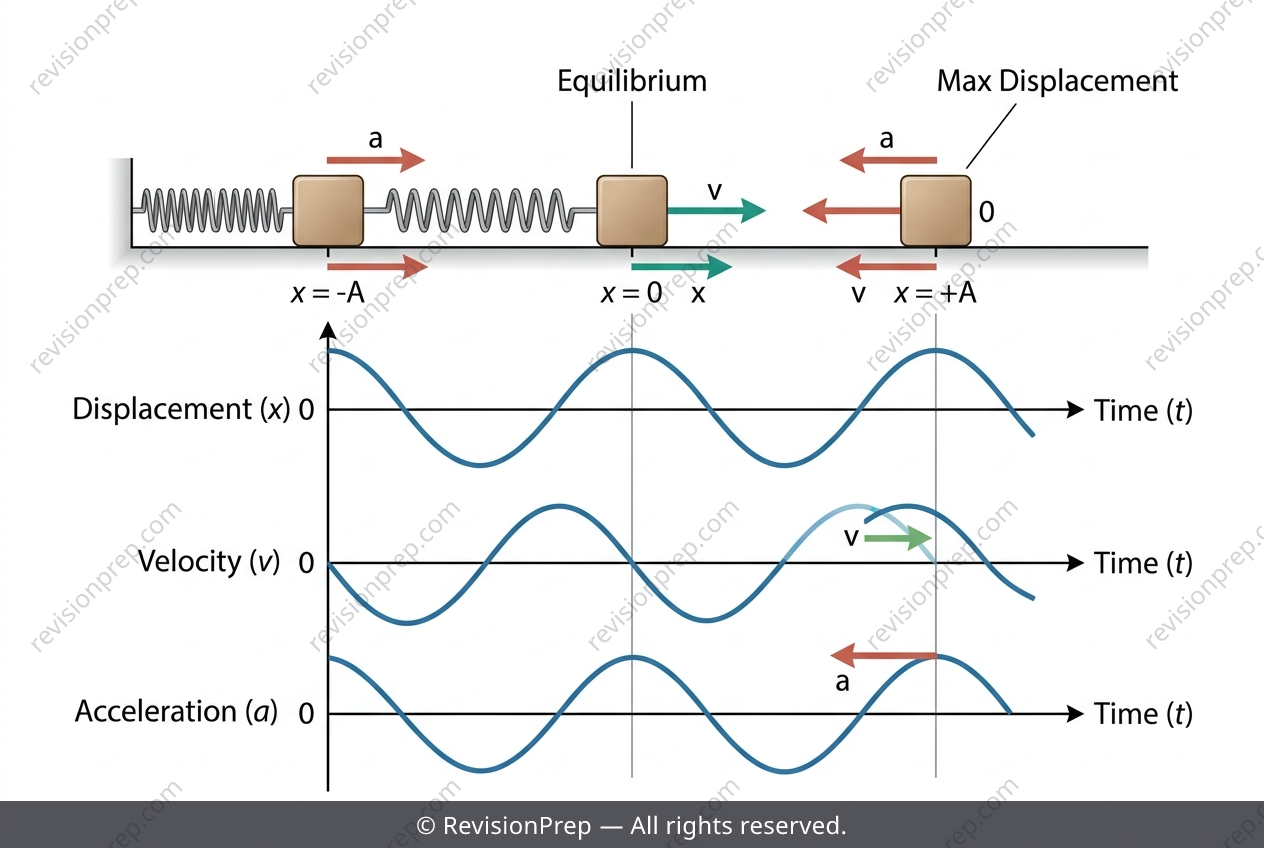
Physics: Displacement Controls Acceleration in SHM
In the study of wave behaviour, few ideas are as central as Simple Harmonic Motion (SHM) — the repetitive back-and-forth movement where the restoring force is directly proportional to displacement. For an IB Physics SL student, mastering SHM means understanding not just where an object is, but how its velocity and acceleration change at every single point along its path. This instantaneous picture—often called the kinematics of SHM—reveals the elegant, predictable rhythm hidden inside oscillations, from pendulums to sound waves. The key relationship that governs this motion is a = −ω²x, where a is acceleration, ω is the angular frequency, and x is the displacement from equilibrium. This single equation ties everything together: acceleration is always directed toward the centre (hence the minus sign) and grows linearly with distance from it. At the extremes of motion, when the particle reaches its maximum displacement (x = A), the restoring force is strongest, meaning the magnitude of acceleration peaks there. Meanwhile, velocity is zero at that turning point, and maximum as it passes through equilibrium. Understanding how these quantities trade off—position, speed, and acceleration—is what turns a formula into a physical intuition about oscillating systems.
Start practising IB questions today
150,000+ IB-styled questions, criteria-mapped and instantly accessible.