
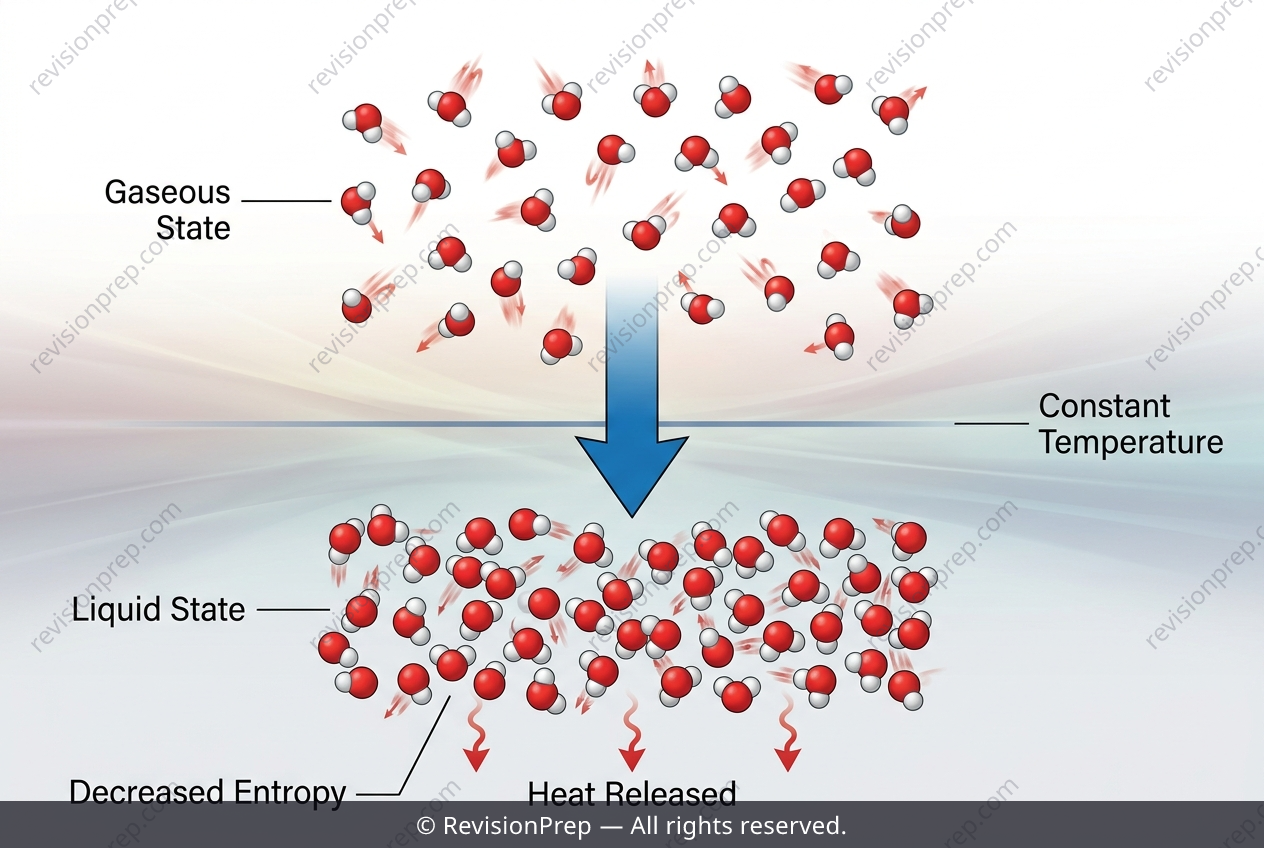
Physics: Entropy Change in Steam Condensation
Entropy change is the measure of energy dispersal per unit temperature, and for a system undergoing a reversible process at constant temperature, it is defined by the simple relationship ΔS = Q/T. In the context of thermodynamics, this quantity tells us how much “disorder” or spread of thermal energy is produced or consumed when heat flows into or out of a substance. For IB Physics HL, mastering this concept is essential because it bridges the microscopic idea of molecular motion with macroscopic observations like phase changes, and it underpins the second law of thermodynamics. When a substance changes phase, such as steam condensing into liquid water, the temperature remains constant while thermal energy is released. Because condensation is an exothermic process, the heat transfer Q for the steam itself is negative. Applying ΔS = Q/T with a negative Q yields a negative entropy change, reflecting that the steam’s molecules become more ordered as they transition from a dispersed gas to a tightly packed liquid. The magnitude depends solely on the energy released and the fixed temperature of the transition. This relationship shows why entropy change is not just a theoretical abstraction but a practical tool for quantifying energy quality and irreversibility in real engineering systems like power plant condensers.
Start practising IB questions today
150,000+ IB-styled questions, criteria-mapped and instantly accessible.