
Physics: Entropy — The Cost of Useful Energy
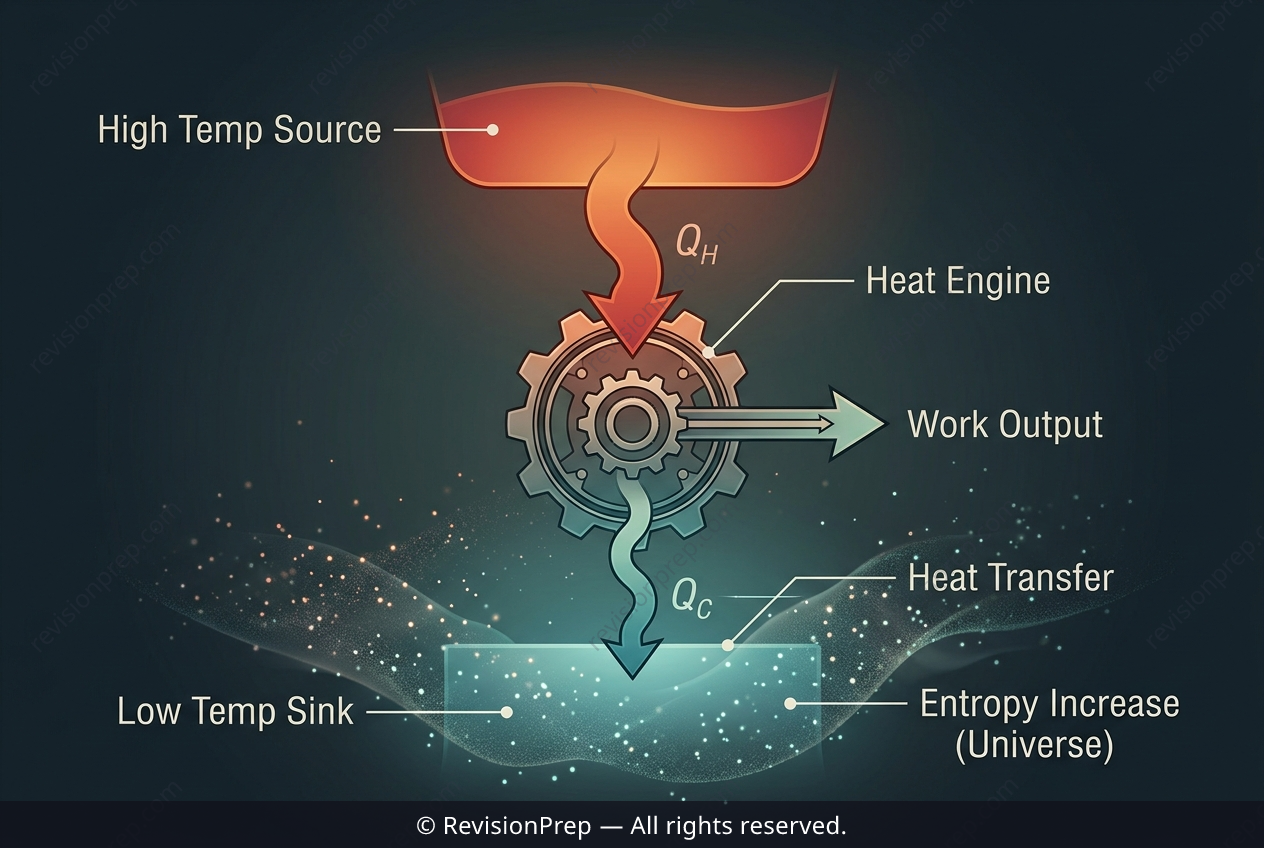
Entropy is the universe’s accounting system for energy’s availability—it tells you not just how much energy exists, but how much of it can ever be turned into useful work. In the particulate nature of matter, the Second Law of Thermodynamics emerges from the statistical behaviour of countless particles: energy spreads spontaneously from hotter to cooler regions, and this spreading is measured by the change in entropy, ΔS. For a heat engine, the maximum possible efficiency is set by the Carnot limit, η = 1 − Tc/Th, where Tc and Th are the absolute temperatures of the cold and hot reservoirs. This limit is a direct consequence of entropy—any real engine must reject some heat to the cold reservoir, and that rejected heat carries entropy with it. When you calculate the entropy change of the hot tank (negative, as it loses heat) and the surroundings (positive, as they gain heat), the total entropy of the universe always increases for a real, irreversible process. That increase is the price of doing work: it quantifies how much “usefulness” has been permanently degraded. Crucially, entropy tells you whether a process can happen at all, but not how fast—a thermodynamically allowed process might still be kinetically negligible.
Start practising IB questions today
150,000+ IB-styled questions, criteria-mapped and instantly accessible.