
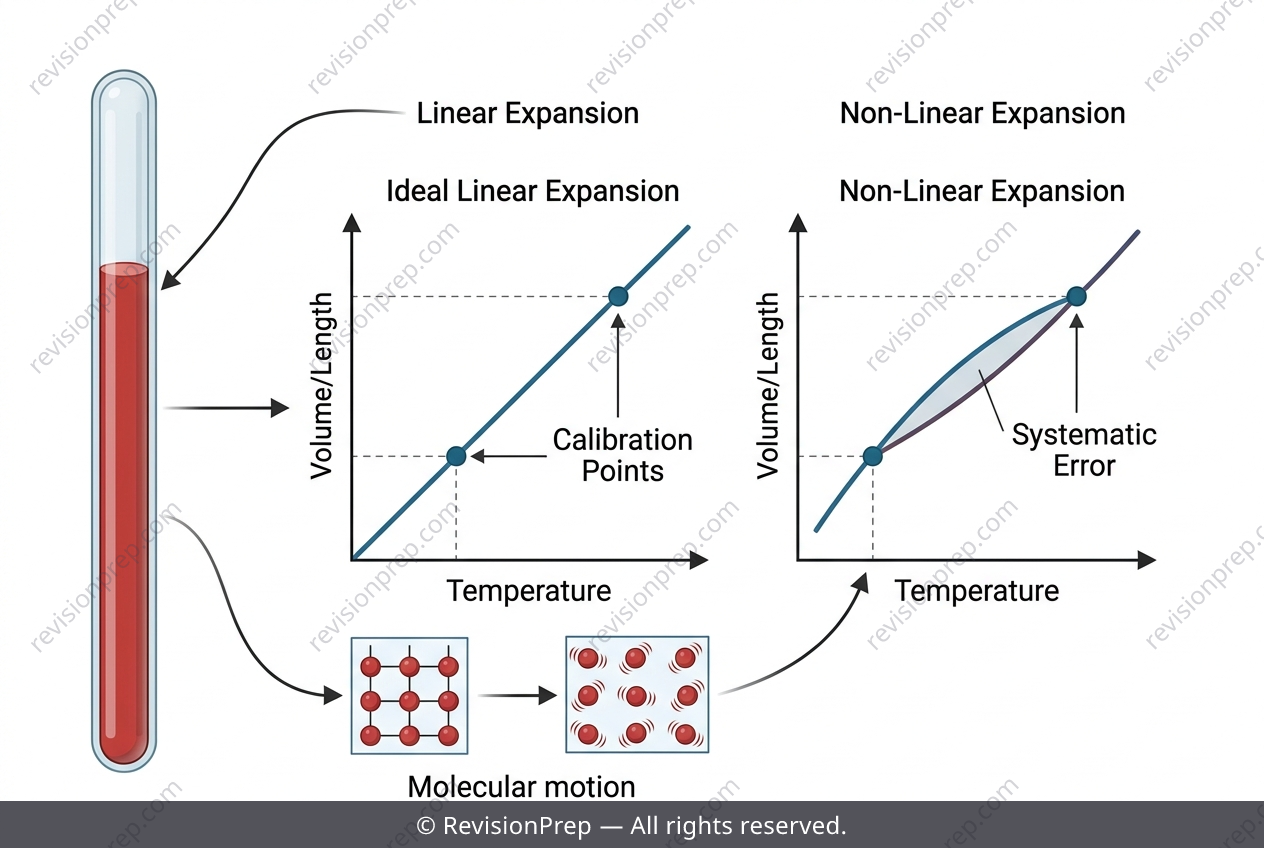
Physics: From Expansion to a Temperature Reading
Temperature is one of the most fundamental measurements in physics, yet the way we quantify it is surprisingly indirect. At its core, the particulate nature of matter tells us that temperature reflects the average kinetic energy of particles—but a thermometer doesn’t count particle speeds. Instead, it exploits a consequence: as particles move faster with increasing temperature, the substance expands. This thermal expansion becomes the physical bridge between an invisible microscopic property and a readable macroscopic scale. A liquid-in-glass thermometer relies on two key features working together. The bulb holds a large volume of liquid, ensuring that even tiny temperature changes produce a measurable overall expansion. The capillary—a narrow bore—then amplifies that small volume change into a visible shift in column length. This mechanism is quantified by a linear interpolation formula: T = (L − L₀) / (L₁₀₀ − L₀) × 100 °C, where L₀ and L₁₀₀ are the column lengths at the fixed calibration points of 0 °C and 100 °C. This assumes the liquid expands perfectly linearly between those points, which is an approximation. Real liquids deviate from this ideal behaviour, especially far from the calibration temperatures, introducing a systematic error—one that repeated measurements cannot correct. Understanding this relationship between expansion, scale construction, and inherent limitation is essential for interpreting any temperature reading with confidence.
Start practising IB questions today
150,000+ IB-styled questions, criteria-mapped and instantly accessible.