
Physics: Greenhouse Effect — Earth's Energy Balance
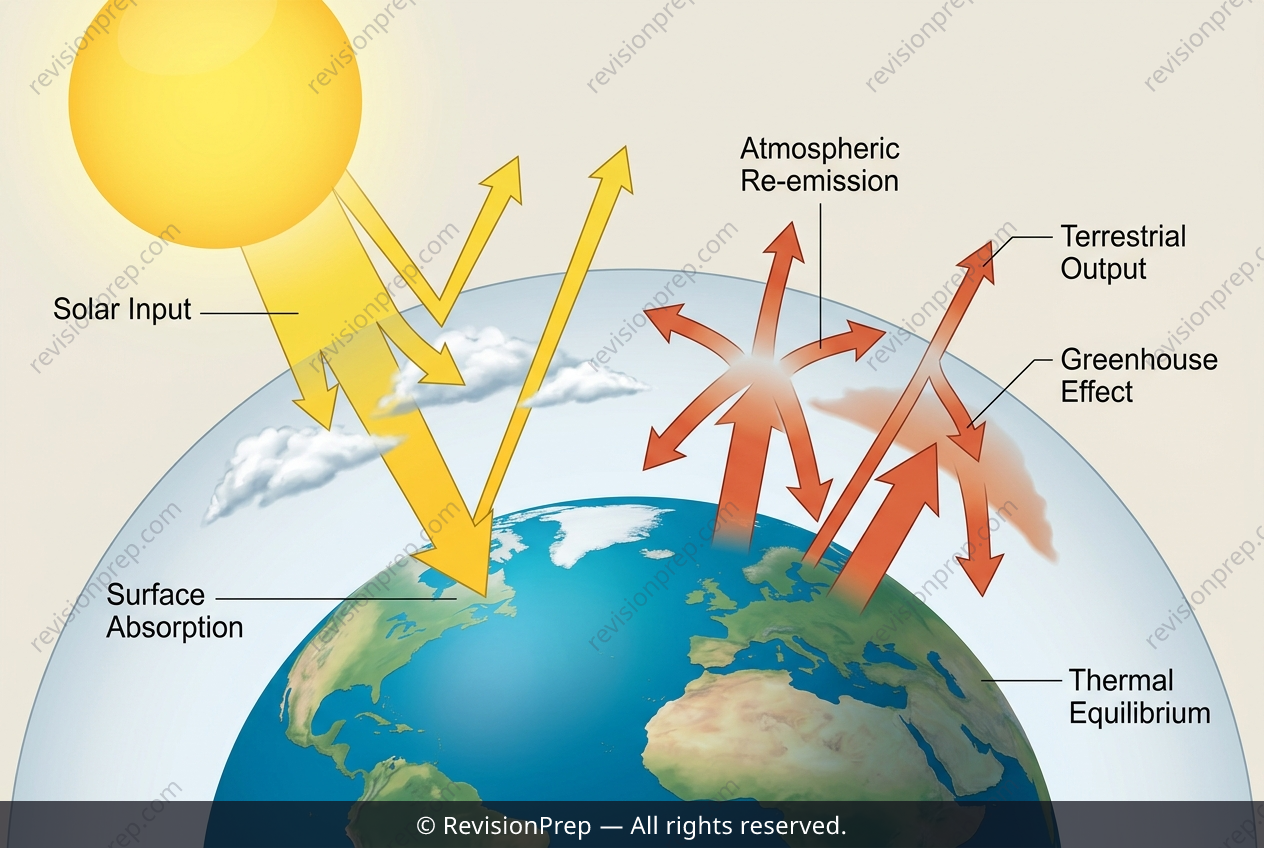
The particulate nature of matter underpins one of the most consequential balances in Earth’s climate system: the energy budget. At the top of the atmosphere, incoming solar radiation delivers a fixed average intensity, but the fate of that energy—reflection, absorption, and re-emission—determines the planet’s equilibrium temperature. This topic connects microscopic photon–molecule interactions to macroscopic climate outcomes, making it a core concept in IB Physics HL. The key mechanism is the greenhouse effect, driven by the atmosphere’s selective absorption of terrestrial radiation. While the surface absorbs a portion of incoming solar energy, it also emits its own radiation at a much higher intensity. The atmosphere intercepts most of this outgoing terrestrial radiation, re-emitting a significant fraction back downward. This downward flux adds to the surface’s energy input, forcing it to emit more until a new balance is reached. The Stefan-Boltzmann law, I = σT⁴, links this equilibrium intensity to temperature, showing that without the atmosphere’s re-emission, the surface would radiate far less and remain much colder. The net imbalance—input minus output—quantifies the warming, and the resulting temperature aligns closely with observed global means, validating the black-body approximation as a first-order model.
Start practising IB questions today
150,000+ IB-styled questions, criteria-mapped and instantly accessible.